Keypads, seals, straps, pet bowls, grips — silicone is everywhere in consumer and industrial products. Two processes dominate: compression molding of solid silicone and liquid silicone rubber (LSR) injection molding. The choice affects tooling cost, precision, flash and unit price.
Compared
| Factor | Compression molding (HCR) | LSR injection molding |
|---|---|---|
| Tooling | Simpler and cheaper molds | Higher-cost molds, often with cold runners |
| Cycle and labor | Longer cycles, more manual handling and trimming | Short cycles, highly automated |
| Precision | Good for simple shapes | Better for thin walls, fine details, tight tolerances |
| Flash | Typically requires deflashing | Can be very low with good tooling |
| Volumes | Low to medium | Medium to high |
Specifying silicone parts
- Hardness in Shore A (typical range roughly 20–80 Shore A) with a tolerance
- Color reference (Pantone or physical sample) and acceptable variation
- Grade: general, food-contact or skin-contact — ask for documents for the relevant market
- Surface: gloss, matte, texture; any coating
- Post-curing requirement where low odor or low volatiles matter
- Flash and parting-line limits on cosmetic surfaces
Questions to ask silicone suppliers
- Which silicone grade and supplier will be used, and what documents exist for the intended use (e.g. food or skin contact)?
- How is hardness measured and controlled lot to lot?
- How is color matched and approved — against a physical sample under defined light?
- What is the deflashing method, and what flash is acceptable on functional edges?
- Is post-curing included, and at what conditions?
- For bonded parts: what primer or self-bonding grade is used, and how is adhesion tested?
Silicone parts often look simple, so details are left unspecified. Typical issues in production are color variation between batches, odor from insufficient post-cure, and inconsistent hardness affecting button feel or sealing. Agree these points with approved samples before mass production.
From prototype to production
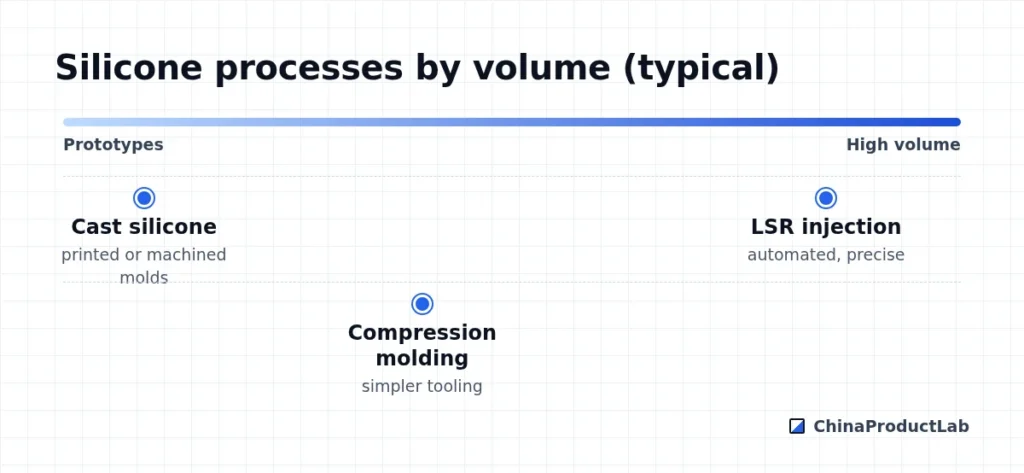
Silicone prototypes are often made by casting liquid silicone into 3D-printed or machined molds. This is fast and cheap, but the material and hardness may differ from the production grade, and cast parts do not show flash, parting lines or shrinkage the way molded parts will. Treat them as shape and fit samples rather than final validation parts.
For the first production tool, a compression mold is often the lower-risk choice when volume is uncertain. If volume grows, an LSR tool can follow, using the experience from the compression-molded parts. Keep the design compatible with both where possible: avoid extremely thin features that only LSR can fill, and define the critical dimensions and appearance standards independently of the process. That way you can move between suppliers and processes without redesigning the part.
Design tips
- Silicone stretches — undercuts are easier than in rigid plastics
- Keep wall thickness reasonably uniform
- Add draft where possible, even though flexible parts can be stripped
- Plan bonding to plastic or metal (overmolding) with compatible primers or self-bonding grades
For prototypes, silicone can also be cast — see vacuum casting. Related: pet product manufacturing and overmolding.