The pilot run went well because the engineer stood next to the line. In mass production, new operators assemble the product on night shift, and small differences — a cable routed on the other side, a screw not fully tightened — create defects. Work instructions capture the knowledge of the pilot run so that every unit is built the same way.
What a good instruction looks like
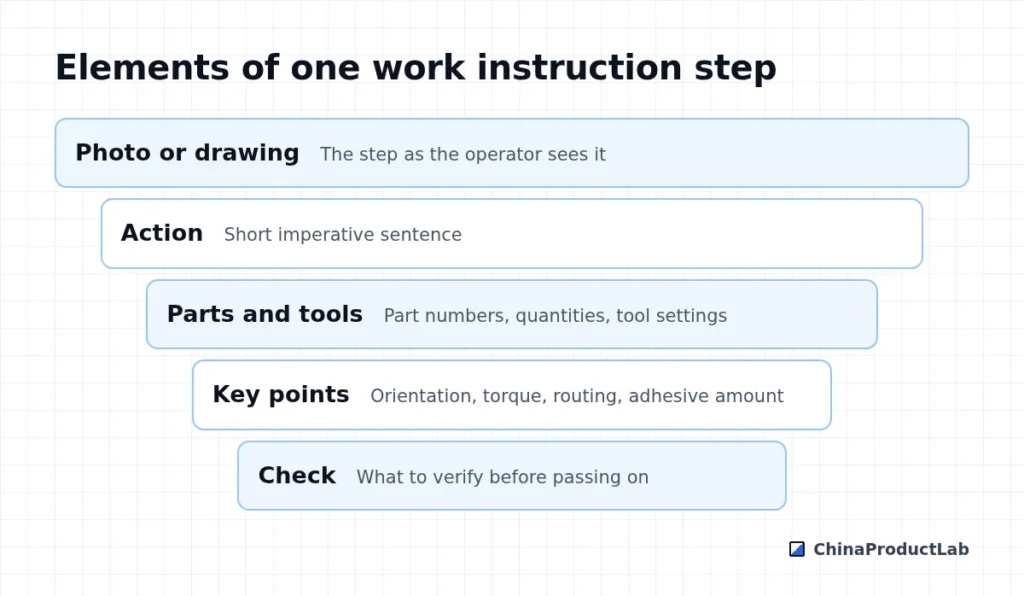
- One clear action per step
- Real photos from the production line, with arrows and highlights
- Critical-to-quality points marked visibly
- Torque values and tool settings
- Good / not good examples for cosmetic and routing steps
- Language the operators read fluently
Version control
| Practice | Why |
|---|---|
| Revision and date on every instruction | Operators and auditors see the current version |
| Linked to product revision | Changes in design reach the line |
| Old versions removed from stations | Prevents mixed builds |
| Changes reviewed with the line leader | Practical feedback and training |
Digital vs. paper instructions
Paper instructions in sheet protectors are still common and work well when kept current. Digital instructions on screens at each station make updates easier and can show videos for complex steps, but require hardware and a system to distribute versions. Whatever the format, operators must be able to see the instruction for their step without searching.
- Visible at the station, at eye level
- Current version only, with clear revision
- Photos and videos taken from the operator’s viewpoint
- Critical steps highlighted with color or symbols
- Space for operator feedback on unclear steps
Visit the line periodically and compare actual work with the instructions. Where operators have found a better way, update the instruction; where they skip a critical step, investigate why.
Training and qualification
Instructions work only with training. New operators should learn each step with a trainer, build sample units that are checked, and be signed off before working alone on critical stations. Keep a simple skills matrix showing who is qualified for which steps. When instructions change, retrain the affected operators and record it. These practices are standard in well-run factories and are worth checking during supplier audits, because they explain much of the difference in quality between suppliers.
Linking instructions to quality data
When a defect is traced to an assembly step, update the instruction for that step and note the change. Over time, the instructions reflect the product’s quality history and become the most practical record of how it should be built.
Building them efficiently
Write the first draft during the pilot build, when the steps are being worked out. Ask the supplier’s engineers to produce instructions in their own format and language, then review them for completeness against your critical points. Use them to train operators, and observe the first production days to see where people deviate — those are the steps that need better instructions or error-proofing.
Related: box build assembly, PFMEA and control plans and fasteners and hardware.