Twelve different screw sizes, three head types and a special standoff nobody stocks — small-batch products often end up with a hardware list that is expensive to buy and slow to assemble. Hardware is cheap per piece but drives assembly time, errors and shortages.
Selection basics
| Choice | Recommendation (typical) |
|---|---|
| Standard | ISO metric sizes from common standards (e.g. ISO 7380, ISO 4762, DIN 912) |
| Material | Stainless (A2/A4) for corrosion; zinc-plated or black-oxide steel for cost; check galvanic pairing with aluminum |
| Drive | Hex socket or Torx for reliable automated or repeated assembly |
| Locking | Thread-locking compound, nylon-insert nuts or lock washers based on vibration |
| Sheet metal | Self-clinching nuts, studs and standoffs instead of loose hardware |
Consolidate the hardware list
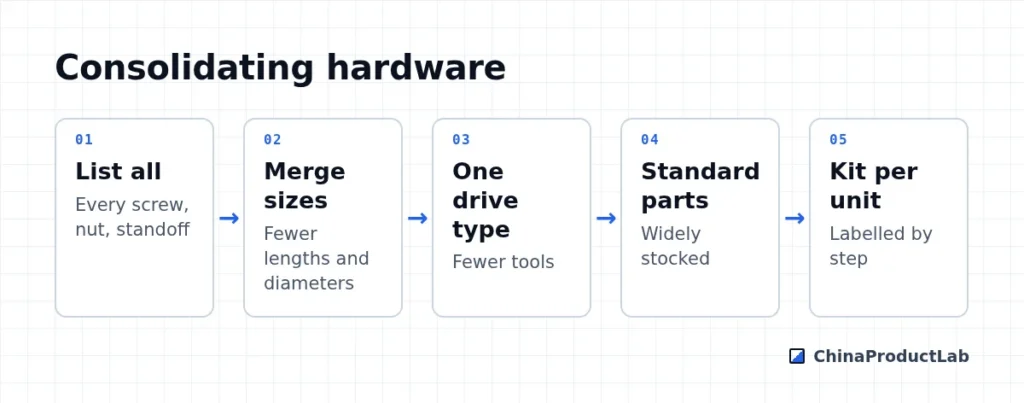
- Use as few sizes and lengths as possible across the product
- One drive type so assembly needs fewer tools
- Avoid lengths that are rare in the market
- Avoid custom parts unless they replace several standard ones
- Name every hardware item in the BOM with standard, size, material and finish
- Add a few percent spare for small hardware in each kit
Assembly efficiency
For small batches, assembly labor often costs more than the hardware itself. Design choices that save minutes per unit add up quickly:
- Captive screws for covers that are opened in service — no lost screws
- Self-clinching fasteners pressed into sheet metal so no nut needs to be held
- Snap fits or hinges where a screw only holds a light part in place
- Same screw for all positions, so assemblers cannot mix them up
- Screws accessible from one direction with standard tools
- Hardware packed in kits per unit, labeled by assembly step
Ask the assembler to review the hardware list before it is frozen; they will quickly spot screws that are hard to reach, mixed sizes and parts likely to be lost.
Sourcing in practice
Standard metric fasteners are widely available, but small-batch projects often face minimum order quantities of thousands of pieces per size and finish. Options include buying from distributors with smaller pack sizes, standardising sizes across several products to combine volume, or letting the assembler source hardware from their regular stock under your specification.
Special finishes — black stainless, colored anodized aluminum screws, specific plating thicknesses — often have longer lead times and higher minimums. Use them only where they are visible or functionally needed. For imported products, also check whether certain finishes or coatings are restricted in your market, and ask suppliers for the relevant declarations. Finally, keep approved samples of each hardware item; a screw that looks the same but has a different head height can cause assembly problems that take time to trace.
Supply and quality
Standard hardware is usually easy to source in China, but specify the standard and property class (e.g. 8.8 for steel bolts) to avoid substitutions. For safety-relevant joints, ask for material certificates and define torque values in the assembly instructions.
See sheet metal design, reduce BOM shortage risk and small-batch manufacturing.