Two quotes for the same part differ by a factor of two. Is one supplier overcharging, or did the other misunderstand the drawing? A should-cost model estimates what a part ought to cost from its materials and processes. It does not have to be precise to be useful — even a rough breakdown shows where quotes differ and which design features drive cost.
Building blocks
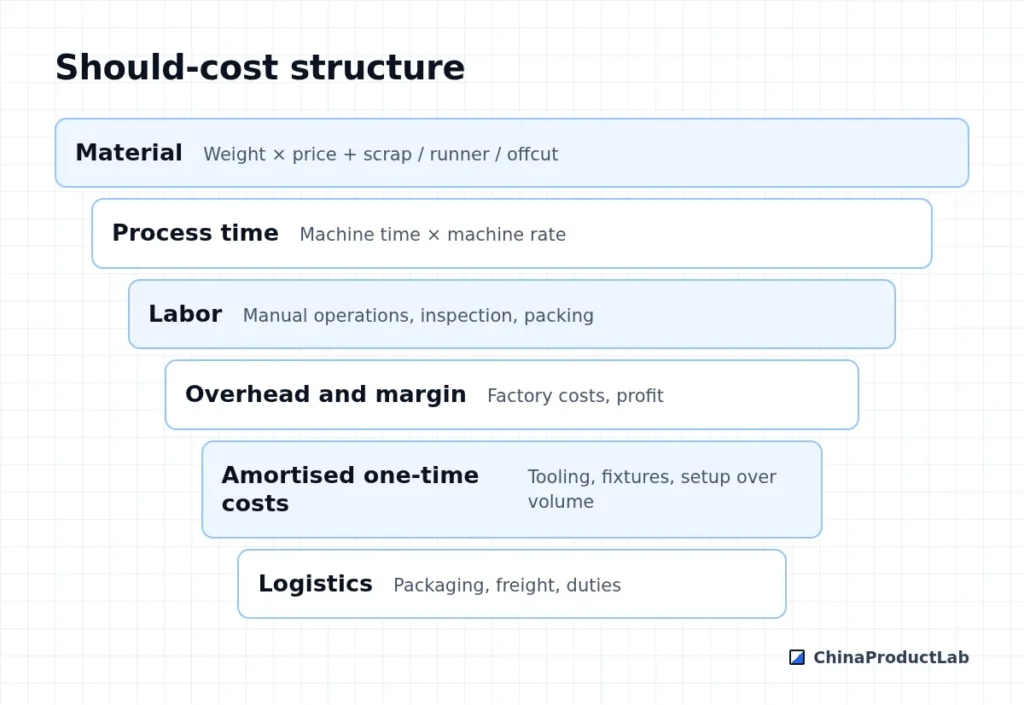
Example: what to estimate
| Process | Main cost drivers to estimate |
|---|---|
| Injection molding | Part + runner weight, resin price, cycle time, cavities, machine size |
| CNC machining | Stock size, machining time, setups, tolerances, finishing |
| Sheet metal | Blank size and nesting, cutting time, number of bends, hardware, finish |
| PCB assembly | Component cost, placements, through-hole and manual work, test time |
Use public material price indices, typical machine rates for the region and time estimates from experienced engineers or CAM software. Document assumptions, so you can update them as prices change.
Using it with suppliers
- Ask for quotes broken down into the same categories
- Compare category by category to find where quotes differ
- Discuss differences as questions (“which cycle time did you assume?”), not accusations
- Use the model to test design changes before asking for new quotes
- Accept that suppliers need a fair margin to stay reliable
Large differences usually come from different assumptions: a different process, more setups, a tighter interpretation of tolerances, or a missing operation. Clarifying them often improves both price and quality, because the supplier’s assumptions become visible.
Keeping the model useful
A should-cost model is most valuable when it is reused. Build a simple template for each main process with the same structure, and record actual quotes alongside estimates. Over time, the comparison shows where your assumptions are too optimistic or too conservative, and estimates become more reliable.
Share the model with engineering, not only purchasing. When designers can see that a tight tolerance adds a machining step or that a part weight drives most of the cost, they make better decisions early. Cost awareness during design typically saves more than negotiation after quotes arrive.
Example of a quick estimate
For a molded part, multiply the shot weight by the resin price, add a margin for scrap, then divide the cycle time by the number of cavities and multiply by a typical machine rate. Add packing and overhead. The result will not match any quote exactly, but if a quote is far higher, you know where to ask questions.
Limits
Should-cost estimates carry uncertainty, especially for complex parts or new processes. Use them as a guide for discussion and design decisions, not as a target price imposed on suppliers. Supplier capacity, quality systems and service matter too — the lowest quote is not always the lowest total cost.
Related: comparing quotations, value engineering and CNC cost drivers.