Three suppliers, three quotations, three formats — and a price difference so large that one of them must be wrong. Usually none of them is wrong: they simply priced different things. One includes tooling, one amortises it into the part price; one quotes FOB, another EXW; one assumed anodizing, another did not read the note. Before you compare prices, you have to make the quotes describe the same job.
Anatomy of a complete quotation
| Line item | What it should state | Why it matters |
|---|---|---|
| Part / product reference | Part number, drawing revision | Confirms they quoted the current design |
| Unit price per quantity break | e.g. 100 / 500 / 1,000 pcs | Shows how fixed costs are spread |
| Tooling / fixtures / NRE | One-time cost, ownership, mold life | Often the largest hidden difference |
| Material | Grade and standard, certificate if required | Cheaper “equivalent” grades change the part |
| Finishing | Process, color, standard, masking | Frequently omitted or assumed |
| Samples | Quantity, cost, lead time, number of rounds | Sample rounds drive the schedule |
| Inspection | What is measured, report type | Separates “made” from “verified” |
| Packaging | Bulk, individual, retail; labels | Affects damage, cost and freight |
| Incoterm and place | EXW, FCA, FOB, DAP, DDP + location | Defines what freight and duties are included |
| Lead time | Samples, tooling, production — separately | A single number hides the critical path |
| Validity and payment terms | Quote validity, deposit/balance | Prices of materials and components change |
Normalise before you compare
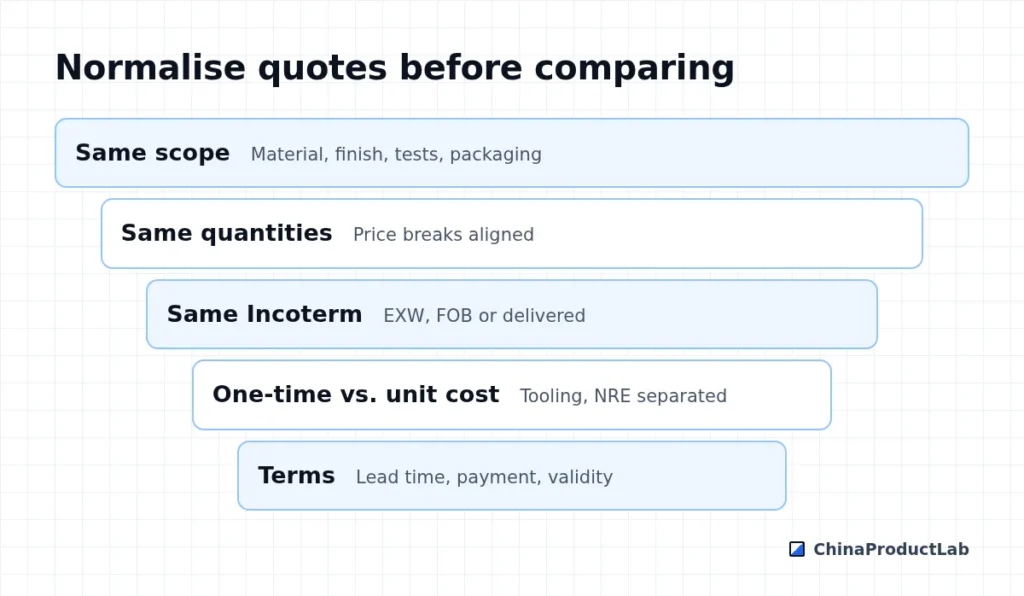
Put every quote into one table with the same rows, then fill gaps by asking each supplier — not by guessing:
- Same quantity breaks for everyone.
- Tooling shown separately and amortised over the same planned volume, so unit prices are comparable.
- Same material grade, finish and inspection scope.
- Same Incoterm and delivery point — or add your own freight and duty estimate.
- Same payment terms, or note the cost of a larger deposit.
- Total cost for your first order and for the first year, not just the unit price.
Total landed cost is explained in custom manufacturing in China; shipping terms in Incoterms explained.
Red flags in a quotation
- A price far below the others with no questions asked about your drawing
- No mention of finishing, inspection or packaging
- Tolerances or materials silently changed (“equivalent material”)
- Tooling price without mold ownership, shot life or number of sample rounds
- One lead time for everything
- Very short quote validity combined with pressure to pay quickly
Questions to send back
- Which drawing revision and which tolerances did you quote?
- Which material grade and standard? Will you provide a certificate?
- Is finishing included as specified, including masking?
- Who owns the tooling, what shot life is guaranteed, and how many sample rounds are included?
- What exactly will be inspected, and what report will we receive?
- What is the Incoterm and delivery point?
- What is the lead time for samples, tooling and production separately?
- What could make the price change before or after order?
Beyond price
The quote is also a test of the supplier. A supplier who asks precise questions, flags cost drivers and states assumptions in writing is usually easier to work with than the cheapest number on the page. See how to choose a manufacturing partner, the cost drivers for CNC parts and injection molds — or send your drawings for an itemized quotation with all assumptions written out.