Most production defects are predictable: a part can be installed upside down, a screw can be missed, a solder joint can be cold. Process FMEA (failure mode and effects analysis) systematically asks what can go wrong at each step before production starts, and the control plan defines how each risk is controlled. Together they replace “we will inspect carefully” with specific, documented controls.
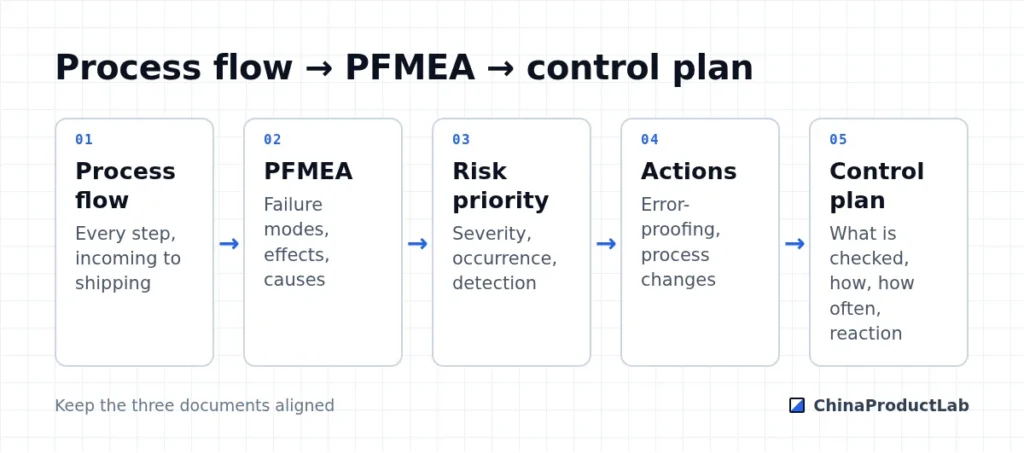
From process flow to control plan
PFMEA in practice
| Step | Failure mode | Effect | Control / action |
|---|---|---|---|
| Insert battery | Reversed polarity | Device dead or damaged | Keyed connector (error-proofing) |
| Screw cover | Screw missing | Loose cover, ingress | Screw counter on driver |
| Apply gasket | Gasket misplaced | Water ingress | Locating groove; leak test |
| Program firmware | Wrong version | Field failure | Station checks checksum and logs |
Risks are rated by severity, occurrence and detection (in newer methods, using action priority tables rather than a single number). The aim is to act first on high-severity failure modes, preferably by error-proofing — making the mistake impossible — rather than by adding inspection.
What a control plan contains
- Process step and characteristic (product or process) to control
- Specification or tolerance
- Measurement method and equipment
- Sample size and frequency
- Recording method
- Reaction plan when out of control
Starting small
For small companies, a full automotive-style PFMEA can feel overwhelming. A practical start is to list the process steps, ask “what can go wrong here?” for each, and focus on failure modes with severe effects. Even a one-page analysis prepared with the supplier’s engineers before pilot production usually reveals several improvements: a missing fixture, an error-proof connector, an extra test step.
Use the same structure every time and expand it as the product matures. When issues occur, check whether they were in the PFMEA — if not, add them and update the control plan. Over time, the documents become a valuable knowledge base for future products and new suppliers.
Reaction plans
Every control needs a reaction: what the operator does when a check fails. Typical reactions are to stop the line, quarantine parts since the last good check, notify the line leader and record the event. Without defined reactions, out-of-tolerance results are noted but not acted on. Make reactions specific and train operators on them, so that problems are contained at the station rather than discovered at final inspection or by customers.
Error-proofing examples
Effective error-proofing is usually simple: connectors that only fit one way, fixtures that hold a part in a single orientation, screwdrivers that count screws, scales that check kit weight, and test stations that block the next step until a pass is recorded. Each removes a decision from the operator and makes a specific mistake physically impossible rather than unlikely.
Asking suppliers for them
Automotive and medical supply chains require these documents; many other suppliers can produce them on request, especially for critical products. Review them together: walk the production line with the control plan in hand and check that the listed controls actually exist. Update both documents after every quality issue and every process change.
Related: 8D reports, production test fixtures and quality agreements.