Engineers test prototypes for an hour with a bench supply and a laptop. In production, each board might get a short time slot — and the test must catch assembly faults reliably, be run by an operator, and record the result. If test is not designed in, it becomes the bottleneck or the place defects slip through.
Test stages
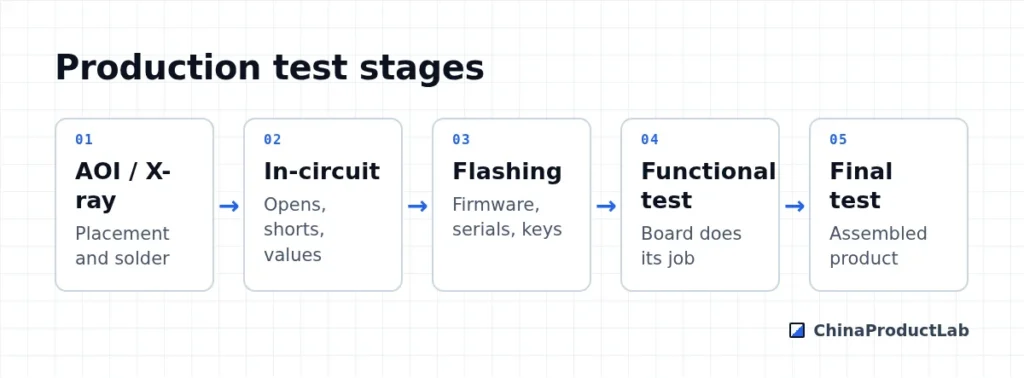
| Stage | Finds | Typical tools |
|---|---|---|
| AOI / X-ray (at assembly) | Placement and solder defects | Automated optical inspection, X-ray for BGAs |
| In-circuit / board test | Opens, shorts, wrong values, power rails | Bed-of-nails fixture with test points |
| Programming | Loads bootloader/firmware, writes serial and keys | Programmer via test pads or connector |
| Functional test | Does the board do its job: sensors, radio, interfaces | Fixture plus test software |
| Final product test | Assembled unit works; buttons, display, sound, connectivity | Test station and checklist |
Design for test
- Test points for power rails, key signals and programming interfaces
- Test points on one side, with spacing suitable for pogo pins
- A test firmware or test mode that exercises hardware and reports results
- Unique serial numbers and how they are written and labeled
- Calibration steps and where the data is stored
- Clear pass/fail limits — not “looks OK”
Balancing test coverage and cycle time
More testing catches more defects, but each second of test time is multiplied by every unit. Decide based on what each test catches:
- Prioritise tests for defects that are likely (assembly faults) or costly (field failures, safety issues)
- Combine programming and functional tests on one fixture where possible
- Run tests in parallel — multiple boards per fixture, or parallel steps in software
- Keep slow tests (burn-in, long RF tests) to sampling plans if the risk allows
- Review failure data regularly and adjust the test plan
Plan the fixture budget and schedule early: fixtures often need several weeks to design and build, and they change when the board layout changes. A fixture that arrives late turns into manual testing at the start of production — exactly when defects are most likely.
Fixture design basics
A production fixture must work thousands of times with operators who did not design it. Mechanical alignment should make it impossible to insert a board the wrong way; pogo pins should be replaceable because they wear; and the fixture should indicate clearly whether the board passed, failed or was not tested. Store the fixture design files and software in your own repository, not only at the supplier.
Plan for maintenance: count pin cycles, keep spare parts, and verify the fixture with a known-good board at the start of each shift.
Running the test
- Fixture and software built and validated before pilot production
- Golden board and known-bad boards to verify the fixture
- Results logged per serial number
- Firmware version control: the factory gets released, checksummed images only
- Secure handling of keys and credentials
Related: PCBA files checklist, EVT, DVT and PVT and embedded hardware.