Material prices rise, the retail price cannot, and the margin quietly disappears. Asking the supplier for “5% off” rarely works twice. Value engineering looks at what the product actually needs to do and removes cost that does not contribute to it — without creating new quality problems.
Start with a cost breakdown
Split the landed cost into parts, assembly, test, packaging, freight and duties. Rank by cost. In many products a handful of parts carry most of the cost — start there.
Where savings usually hide
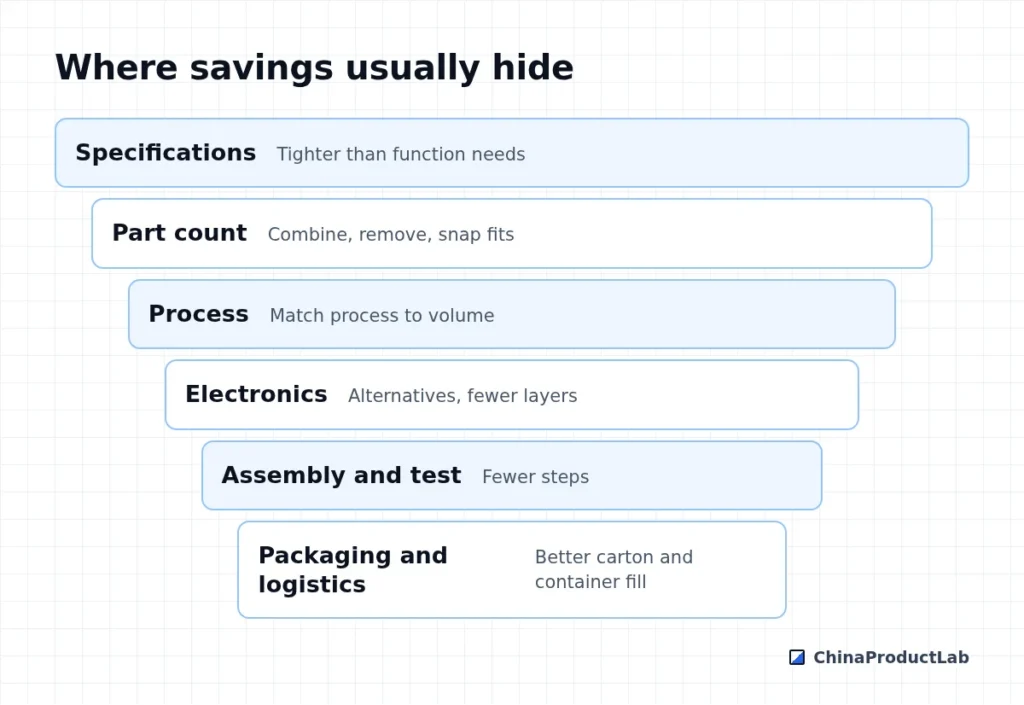
| Area | Typical opportunities |
|---|---|
| Specifications | Tolerances, finishes and materials tighter or better than function requires |
| Part count | Combine parts, replace fasteners with snap fits, integrate brackets |
| Process | Move from machining to molding, casting or extrusion at higher volume |
| Electronics | Alternative components, fewer board layers, panel efficiency |
| Assembly and test | Fewer steps, fixtures, automated tests |
| Packaging and logistics | Smaller cartons, better pallet and container fill |
Process
- List ideas with estimated saving, one-time cost and risk.
- Prioritise quick wins with low risk; plan larger changes as projects.
- Change through formal ECNs, with samples and testing.
- Re-qualify affected functions and compliance (a new material can affect certifications).
- Track actual savings after implementation.
Questions that generate ideas
- What would this part look like if designed today for the current volume?
- Which tolerances and finishes are actually inspected and needed?
- Can two parts become one, or can a part be removed?
- Are we paying for a feature customers do not use?
- Which components have cheaper qualified alternatives?
- What do the supplier’s engineers think — what makes this part difficult or slow for them?
Involving suppliers often yields the best ideas, because they see where cycle time, scrap and manual work occur. Offer to share part of the savings with the supplier; it changes the conversation from a price cut request to a joint engineering project.
Calculating payback
A saving per unit only matters if it pays back the cost of making the change. For each idea, estimate the one-time costs — engineering time, tool modifications, new samples, testing, possible certification updates — and divide by the expected saving per unit times the remaining volume of the product. Ideas with a payback longer than the remaining product life should be dropped, however attractive the unit saving looks.
Also consider timing. Changes are cheapest when combined with planned events: a new tool when the old one wears out, a new revision for another reason, or a new product generation. Keep a list of cost ideas and review it whenever such an event comes up. Finally, measure the outcome. After implementation, compare actual purchase prices and quality data with the assumptions, so that the next round of value engineering starts from real numbers.
Avoid
- Cheaper parts that raise warranty returns
- Changes made by the supplier without approval
- Ignoring tooling and requalification cost in the payback calculation
Related: engineering change management, CNC cost drivers and mold cost. Send your current BOM and drawings for a review.