The new drawing went out by chat. The factory produced the old revision. Nobody can say which units have the fix. Most “quality problems” after a design change are really change-management problems — and they are avoidable with a simple, consistent process.
The basics
- Every part has a number and a revision (A, B, C…) on the drawing and in the BOM
- One controlled place where the current revision lives
- Changes are issued as an engineering change notice (ECN), never as an informal message
- Superseded drawings are marked obsolete
What an ECN should state
| Field | Example |
|---|---|
| Change number and date | ECN-024, 2026-10-18 |
| Parts and revisions | Housing 1002 rev C → rev D |
| Description and reason | Wall thickened at boss to prevent cracking |
| Effectivity / cut-in | From next production batch, or from serial number X |
| Inventory disposition | Use up / rework / scrap existing parts and materials |
| Verification | New first-article inspection, updated golden sample |
| Approvals | Engineering, quality, purchasing; supplier acknowledgement |
Classifying changes
Not every change needs the same effort. A simple classification keeps the process fast for small changes and careful for risky ones:
- Minor — documentation corrections, no effect on form, fit or function: update drawing, notify supplier
- Major — affects fit, function, appearance or tooling: full ECN, samples, first-article inspection
- Critical — affects safety, compliance or certification: ECN plus re-testing or re-certification before shipment
Equally important are changes the supplier wants to make — a different resin source, a new sub-supplier, a process change. Agree in the contract that the supplier must request approval for such changes (often called a process change notification) instead of informing you after the fact. Many unexplained quality shifts trace back to an unannounced supplier-side change.
Costs of a change
Every change has a cost beyond the new drawing. Before approving an ECN, make the full cost visible so the decision is made with the right information:
- Tool modifications and the time the tool is out of production
- Scrap or rework of parts and materials already in stock
- New samples, inspection and testing, possibly re-certification
- Updated packaging, manuals, labels and spare parts
- Effect on lead time for open orders
Batching non-urgent changes into planned revisions reduces this overhead. Urgent changes — safety, compliance, serious field failures — go through immediately, but cosmetic or convenience improvements can usually wait for the next scheduled release.
Keeping records useful
An ECN log is most valuable months later, when a customer reports a problem and you need to know which units contain which version. Record the batch numbers, serial ranges or ship dates where each change took effect, and keep that log with the product’s technical file. Link each ECN to the reason behind it — a test failure, a customer complaint, a cost reduction — so future engineers understand why the design looks the way it does and do not undo a fix by accident.
Closing the loop with the supplier
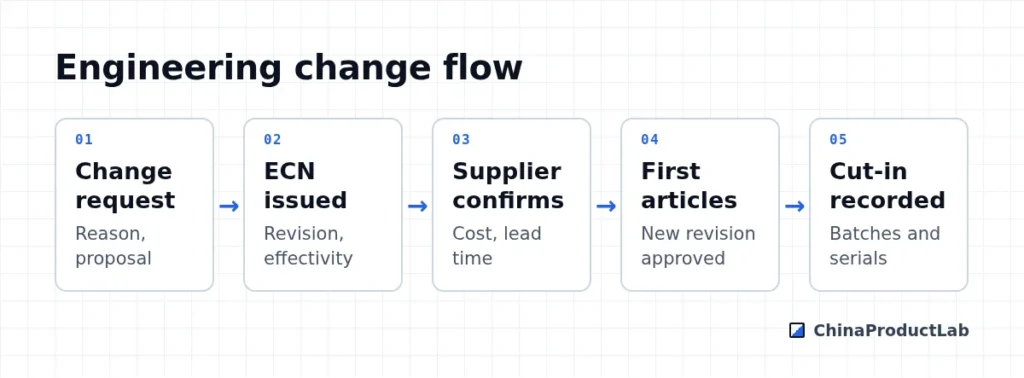
- Send the ECN with the new drawing and 3D file.
- Get written confirmation of the revision that will be produced, cost and lead-time impact.
- Approve first articles of the new revision before shipment.
- Update golden samples and inspection checklists.
- Record which batches or serials contain the change.
Related: golden samples, EVT, DVT and PVT and product development.