Lithium batteries are regulated as dangerous goods in transport. A battery-powered product with missing paperwork does not just cost more to ship — forwarders and airlines can refuse it entirely. Plan the documents while choosing the battery, not when the goods are packed.
Rules change with each edition of the dangerous goods regulations (for example IATA DGR for air). Always confirm current requirements with your forwarder before shipping.
Documents to have
- UN 38.3 test summary for the cell and battery — proof the design passed the UN transport tests
- Safety data sheet (SDS) for the battery
- Battery specification: chemistry, capacity (Wh for lithium-ion), cell count
- Any additional transport classification documents your forwarder requests
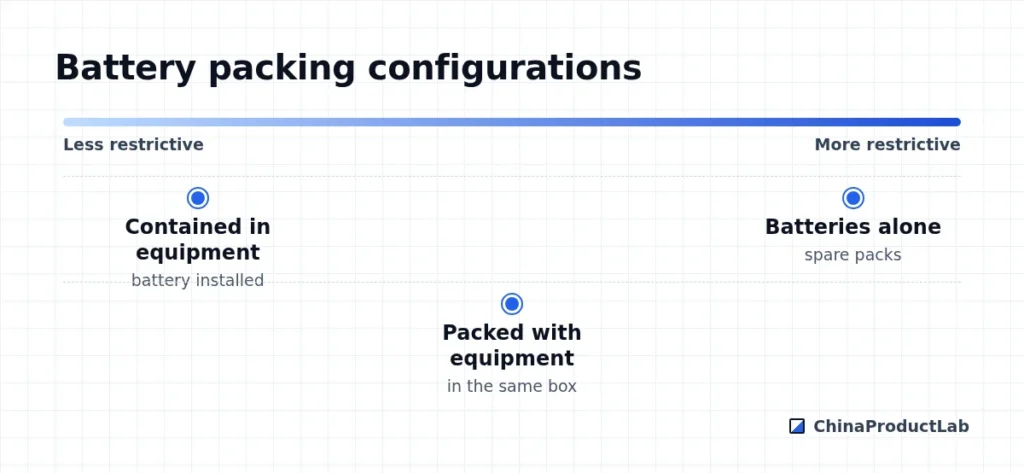
Packing configuration matters
| Configuration | Example | Effect |
|---|---|---|
| Batteries alone | Spare battery packs | Most restrictive, especially by air |
| Packed with equipment | Battery in the box but not installed | Intermediate requirements |
| Contained in equipment | Battery installed in the device | Usually the least restrictive |
Limits also depend on battery size (watt-hours), quantity per package and, for some air shipments, state of charge. Labels such as the lithium battery mark may be required on the outer package.
Before booking the first shipment
- Send the forwarder the UN 38.3 test summary, SDS and battery specifications for the exact battery model.
- Confirm how the shipment will be classified (battery alone, packed with or contained in equipment) and which labels and documents are required.
- Check carrier and route restrictions — some airlines or express services limit or refuse certain battery shipments.
- Agree the packaging configuration with the factory: terminal protection, inner packaging, outer labels.
- Check the state of charge requirement for air shipments and how the factory will set it.
- Keep copies of all documents with the shipment records.
If you sell through marketplaces or retailers, they often require the same documents again — often with their own forms. Collecting a complete battery file once, at the design stage, saves time on every channel.
Design choices that make shipping easier
Some decisions made in engineering simplify logistics for the life of the product. Using a battery installed in the device instead of shipping it separately usually reduces requirements. Keeping capacity within commonly used thresholds for small lithium-ion batteries can avoid more demanding categories — check the current thresholds with your forwarder, because they depend on the regulation and transport mode.
Prefer battery packs from manufacturers who supply complete UN 38.3 documentation and have experience with export shipments. Include protection circuits and a mechanism that prevents the device from turning on in the package. For spare batteries or accessories, consider whether they can be sold separately and shipped by sea or ground. These choices do not just save freight cost; they reduce the risk of shipments being rejected at the last moment.
Design and sourcing tips
- Choose cells and packs from suppliers who provide UN 38.3 documents for the exact model
- Changing the battery pack can require new test documents
- Protect terminals and prevent accidental activation in packaging
- Plan sea freight or ground transport for large battery shipments
- Ask your forwarder before booking — not after the goods are ready
Related: air vs sea vs express, compliance documents and IoT hardware. Send your battery-powered project.