Customs, marketplaces and retail buyers increasingly ask for documents before goods can be sold — and “the factory has it” is not an answer. Requesting the right documents at quotation stage avoids goods stuck in a warehouse while you chase paperwork.
This is general information. Requirements depend on product, market and channel — confirm with your compliance advisor or test lab.
Common documents
| Document | What it covers | Typically from |
|---|---|---|
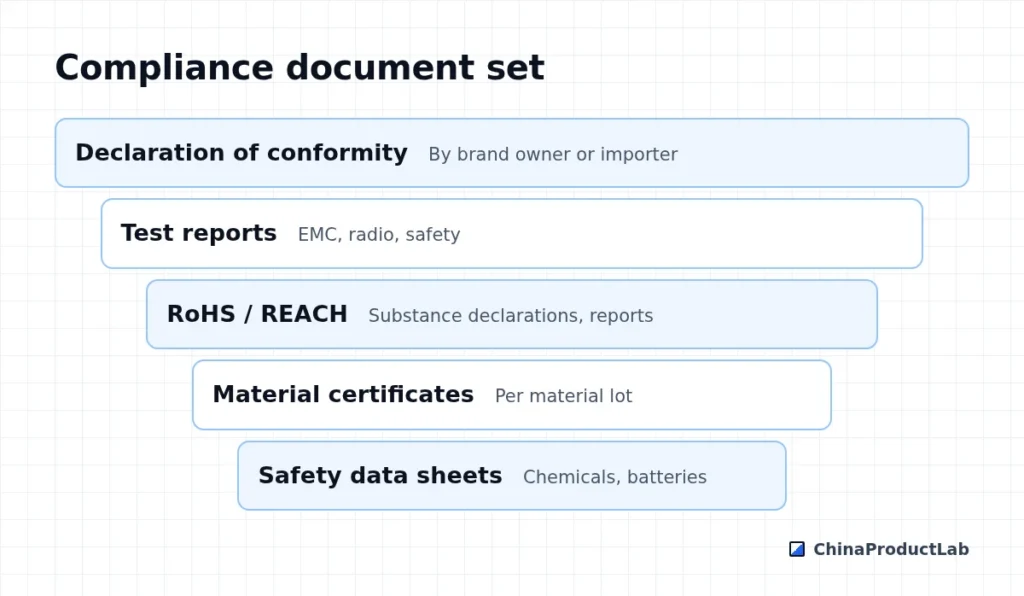
| RoHS declaration / test report | Restricted hazardous substances in electrical and electronic equipment (EU and similar rules) | Manufacturer; test lab for reports |
| REACH SVHC declaration | Substances of very high concern in articles (EU) | Manufacturer, based on supplier data |
| Declaration / certificate of conformity | Which directives or standards the product complies with | Brand owner / importer, supported by test reports |
| Test reports (EMC, radio, safety) | Evidence for CE, FCC, UKCA and similar | Accredited test labs |
| Material certificate | Chemical and mechanical properties of a material lot (e.g. EN 10204 3.1) | Material mill / supplier |
| Safety data sheet (SDS) | Hazards of chemicals, batteries, coatings | Chemical or battery manufacturer |
Checking documents
- Product name and model match exactly — including version
- Issued by an identifiable lab; report numbers can often be verified with the lab
- Date and standard edition are current
- Covers the actual materials and components in your build (not a sister product)
- Updated when the design, materials or suppliers change
When documents go stale
A compliance document is a snapshot of one design at one time. It can become invalid without anyone noticing:
- The supplier changes a component, plastic resin or coating to a “same spec” alternative
- The regulation is updated — for example, the REACH candidate list is extended periodically
- A test report refers to a standard edition that has been superseded
- The product is sold in a new market with its own rules
Practical controls: require suppliers to notify you before material or component changes, ask for updated declarations at least yearly for active products, and keep a document register per product with version, date and expiry or review date. For electronics, ask the PCBA supplier for component-level declarations so you can trace where each substance claim comes from.
Who is responsible?
Under many product regulations, the legal responsibility sits with the brand owner or importer placing the product on the market — not with the factory. The factory provides evidence such as material declarations and test reports, but you must ensure the technical file is complete and that the declaration of conformity is correct for your product.
That has practical consequences. Budget for testing in your own name where needed rather than relying on a supplier’s report for a different product. Decide who holds the technical documentation and for how long. When working with a manufacturing partner, agree in writing which documents they will supply, in which format and by which milestone, and include a contact at each sub-supplier for questions about materials. Gaps found during a marketplace or customs review are much harder to close under time pressure.
Make it part of the order
List required documents in the RFQ and purchase order, with the delivery point (before shipment, not after). For connected products see CE, FCC and UKCA overview; for the RFQ itself see the RFQ checklist. Tell us which markets you sell in.