Freight is often decided at the last minute — and the choice can cost as much as a production change. Express is fast but expensive per kilo; sea is cheap per unit but adds weeks and inventory. The right mode depends on size, weight, value, urgency and the cost of being late.
The three modes
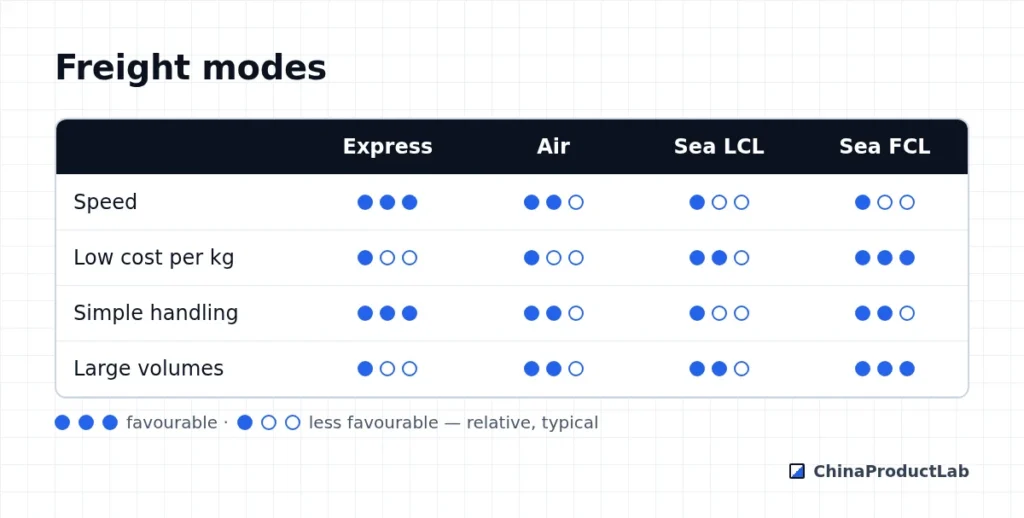
| Mode | Typical transit | Cost basis | Best for |
|---|---|---|---|
| Express courier | Days, door to door | Chargeable weight; simplest handling | Samples, spare parts, urgent small shipments |
| Air freight | About one to two weeks including handling | Chargeable weight via forwarder; airport-to-airport or door-to-door | Medium shipments with time pressure |
| Sea freight LCL | Several weeks plus consolidation time | Volume (CBM) in a shared container | Small volume shipments where time allows |
| Sea freight FCL | Several weeks port to port | Per container (20’/40′) | Large volumes; lowest unit cost |
Chargeable weight
Air and express charge the greater of actual and volumetric weight. A common air-freight formula is length × width × height in cm ÷ 6,000 (couriers often use ÷ 5,000). Light, bulky products pay for volume — compact packaging directly reduces freight cost.
Costs beyond the freight rate
The rate per kilo or per container is only part of the landed cost. When comparing modes, include:
- Origin charges: pickup, export customs clearance, terminal handling
- Destination charges: port or airport fees, import clearance, delivery
- Duties and import taxes (same for all modes, but timing of payment differs)
- Insurance — usually a small percentage of cargo value
- Inventory carrying cost while goods are in transit
- Storage or demurrage if goods are not collected in time
Ask your forwarder for an all-in, door-to-door quote for each mode with the same assumptions, and confirm transit time as door-to-door rather than port-to-port. For regular shipments, a split strategy — air for the first units to launch, sea for replenishment — often balances speed and cost.
Planning shipments around production
Freight choice is easier when it is planned together with the production schedule. Agree a ready date with the factory, add time for pre-shipment inspection and corrections, and book freight after the inspection result is known. Booking sea freight too early can mean missing the vessel if inspection finds problems; booking too late in peak season can mean waiting for space.
Watch the calendar: before Chinese New Year and in the months before Western holiday seasons, demand rises, rates increase and factories and logistics slow down. For launches, work backwards from the date goods must be in your warehouse, and keep a buffer for customs inspection at destination. Ask the forwarder which documents they need from you and the factory — commercial invoice, packing list and any product-specific certificates — so that paperwork does not delay a shipment that is otherwise ready.
How to choose
- Cost of a late launch or empty shelf vs. extra freight cost
- Product value per kilo (high-value electronics often justify air)
- Inventory and cash tied up during weeks at sea
- Dangerous goods (e.g. lithium batteries) limit options and add requirements
- Split shipments: a first batch by air, the rest by sea
- Seasonal peaks and holidays raise rates and transit times
Who books and pays depends on the Incoterm — see Incoterms explained and export packaging. Tell us your destination when you request a quote.