A product that passed every inspection can still arrive broken. Export shipments are stacked, dropped, compressed and exposed to humidity for weeks. Packaging is part of the product specification — and cheaper to engineer upfront than replacing damaged goods.
Packaging levels
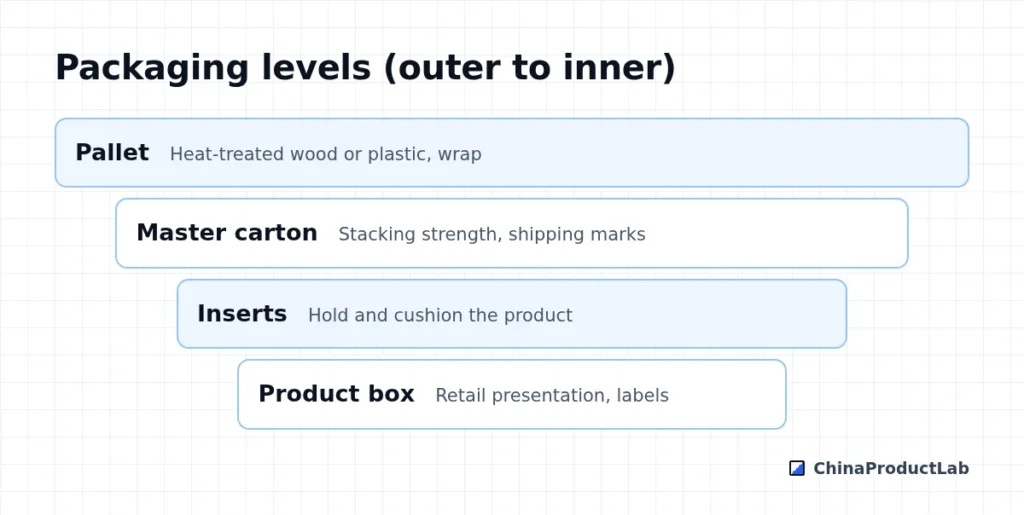
| Level | Purpose | Typical choices |
|---|---|---|
| Primary (product box) | Protect, present, inform | Folding carton, rigid box, clamshell |
| Inserts | Hold the product, absorb shock | Molded pulp, foam, corrugated inserts |
| Master carton | Group units, survive handling and stacking | Single- or double-wall corrugated, sized to a weight limit |
| Pallet | Unitise for freight | Heat-treated wood (ISPM 15 marked) or plastic pallets, stretch wrap, corner boards |
Test before you ship
Transit test procedures such as the ISTA series (for example ISTA 1A/2A for packaged products, 3A for parcel delivery) define drops, vibration and compression for a packaged product. Agree which procedure applies, run it on pre-production packaging, and include it in the inspection plan.
Common packaging failures
Most transit damage follows a few patterns. Reviewing your packaging against them before the first shipment is far cheaper than a claim:
- Cartons crushed in stacking because board grade was chosen for weight, not for stack height and humidity
- Products moving inside the box because inserts were designed for the prototype, not the production part
- Heavy accessories (power supplies, batteries) packed loose and hitting the main product
- Corrosion or mold after sea freight because goods were packed warm and humid without desiccant
- Labels peeling or smudged after condensation in the container
- Pallets overhanging or stretch-wrapped too loosely, so cartons shift in transit
When you approve packaging, approve a packed sample: open it after a drop test, photograph the result, and keep it with the golden samples so the factory has a physical reference for every future batch.
Who designs the packaging?
Packaging often falls between responsibilities: the industrial designer owns the retail box, the factory picks a carton, and nobody checks the whole system. Assign one owner who signs off the complete packaging specification — product box, inserts, master carton, labels and pallet pattern.
Factories and packaging suppliers can propose structures and samples, but give them clear inputs: product weight and fragile areas, target number of units per carton, shipping mode, destination climate and any retailer or warehouse requirements. Check the carton dimensions against pallet and container sizes early; a carton a few millimeters too large can waste a full layer of a pallet, which adds freight cost to every shipment for the life of the product.
Checklist
- Carton strength suited to stack height and container weight
- Inserts keep the product from touching the carton walls
- Accessories secured so they cannot hit the product
- Desiccant and moisture barrier for sea freight; avoid sealing in humid conditions
- Master carton weight within manual-handling limits of the destination
- Shipping marks: consignee, PO, carton x of y, gross/net weight, dimensions
- Country of origin and required compliance marks; handling symbols
- Barcodes and labels per your retailer or warehouse requirements
Packaging is checked at pre-shipment inspection; freight choices are covered in manufacturing lead times. Include packaging in your RFQ for a complete quote.