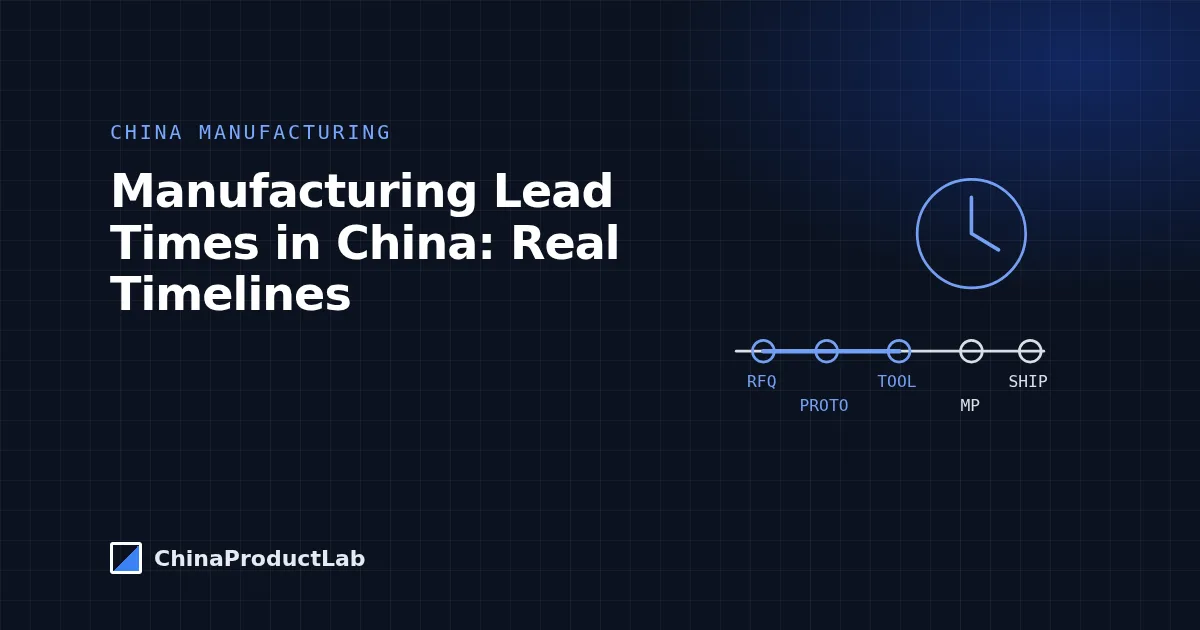
“Production takes four weeks” sounds like a delivery date. It rarely is. The quoted production time is only one block in a chain that starts with your RFQ and ends when goods arrive at your warehouse — and the other blocks (sample approval, tooling, component sourcing, freight, holidays) are where launch dates are usually lost. This guide breaks the timeline into its real parts so you can plan backwards from the date you actually need.
The full timeline at a glance
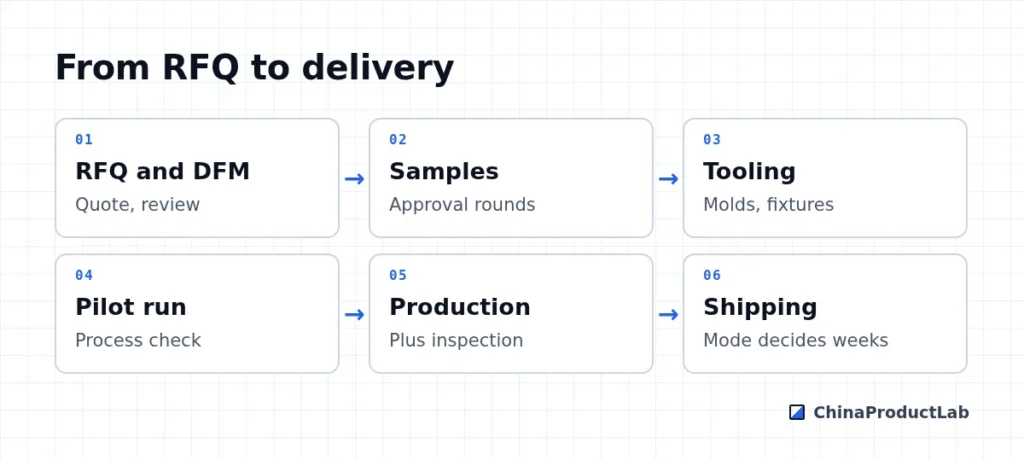
| Stage | Typical duration | What drives it |
|---|---|---|
| RFQ → quotation | A few days to ~2 weeks | Completeness of drawings, number of processes, supplier questions |
| Prototypes / first samples | ~1–3 weeks | Process (printing, CNC, sheet metal, PCBA), finishing, shipping to you |
| Your testing and approval | Often 1–4 weeks | Your internal tests and decision speed — frequently underestimated |
| Tooling (if needed) | ~4–8 weeks for typical molds; longer for complex tools | Part size, slides/lifters, cavities, steel, workload |
| Tool trials and corrections | ~1–3 weeks per sample round | Number of rounds (T1, T2…), dimensional and cosmetic issues |
| Material and component sourcing | Days to many months | Stock materials vs. long-lead electronic components |
| Production | ~2–6 weeks | Quantity, number of processes, finishing, assembly, factory schedule |
| Inspection and packing | A few days | Inspection scope, rework if defects are found |
| Shipping and customs | Days (express) to weeks (sea) | Freight mode, route, season, customs clearance |
All durations are typical ranges, not commitments — every project gets its own schedule in the quotation.
Typical durations by process
| Process | Prototype / first parts | Notes |
|---|---|---|
| 3D printing | A few days to ~1 week | Finishing (painting, dyeing) adds time |
| CNC machining | ~1–2 weeks | Anodizing, plating or tight tolerances add days |
| Sheet metal | ~1–2 weeks | Powder coating and hardware insertion add days |
| PCB assembly | ~2–4 weeks | Board fabrication + components; long-lead parts can dominate |
| Injection molding | Tooling ~4–8 weeks + sample rounds | Aluminum or bridge tools can be faster |
Shipping: choose the mode with the calendar
| Mode | Typical transit | Best for |
|---|---|---|
| Express courier | ~3–7 days door to door | Samples, urgent small shipments |
| Air freight | ~1–2 weeks including handling and clearance | Medium shipments with time pressure |
| Sea freight | Several weeks port to port, plus loading, clearance and inland delivery | Volume shipments where cost matters more than speed |
Sea transit varies a lot by route and season; ask your forwarder for current schedules. The Incoterm decides who books and pays — see Incoterms explained.
Calendar effects most buyers forget
- Chinese New Year (January or February): many factories stop for several weeks, with slowdowns before and a gradual restart after. Orders that should ship in February need to be placed months earlier.
- Golden Week (early October) and other public holidays pause production and logistics.
- Peak shipping season before Western holidays fills vessels and raises freight rates.
- Your own holidays: approvals waiting in an inbox during summer or December delay the whole chain.
Why schedules slip
- Incomplete RFQ — questions and re-quotes before anything starts (see the RFQ checklist).
- Slow sample approval — the supplier waits while samples sit in testing.
- Design changes after tooling — every change means tool modification and another sample round.
- Long-lead components discovered late (see BOM shortage risk).
- Failed inspection — rework before shipment.
- Certification testing scheduled after production instead of in parallel.
How to shorten the timeline safely
- Send a complete RFQ package the first time.
- Agree decision owners and approval deadlines for each sample round.
- Order long-lead components as soon as the part choice is stable.
- Run certification pre-testing in parallel with tooling.
- Use bridge tooling or machined parts to start selling while production tools are made.
- Book freight early around holidays and peak season.
- Plan backwards from the date goods must be in your warehouse — and add a buffer.
An illustrative timeline
For a molded plastic enclosure with a simple PCBA, a realistic plan often looks like this — each step can be shorter or longer depending on the project:
- Weeks 1–2: RFQ, DFM questions, quotation.
- Weeks 2–5: prototypes and testing; design freeze.
- Weeks 5–12: mold making and PCBA sourcing in parallel.
- Weeks 12–15: T1/T2 samples, corrections, golden sample approval.
- Weeks 15–19: production, final test, inspection and packing.
- Then: shipping — about one week by air or several weeks by sea.
Stages are explained in EVT, DVT and PVT and custom manufacturing in China. Have a target launch date? Send your project and the date you need goods — we will propose a schedule working backwards from it.