One supplier, one mold, one factory — and a single fire, capacity crunch or dispute stops your business. A second source reduces that risk, but it costs money and attention. The goal is a backup that can produce to the same standard without repeating the entire development.
Is it worth it?
- How long would it take to recover if the current supplier stopped today?
- What is the revenue impact of that gap?
- Can safety stock cover it more cheaply?
- Which parts are truly custom and which can be bought from many sources?
Options
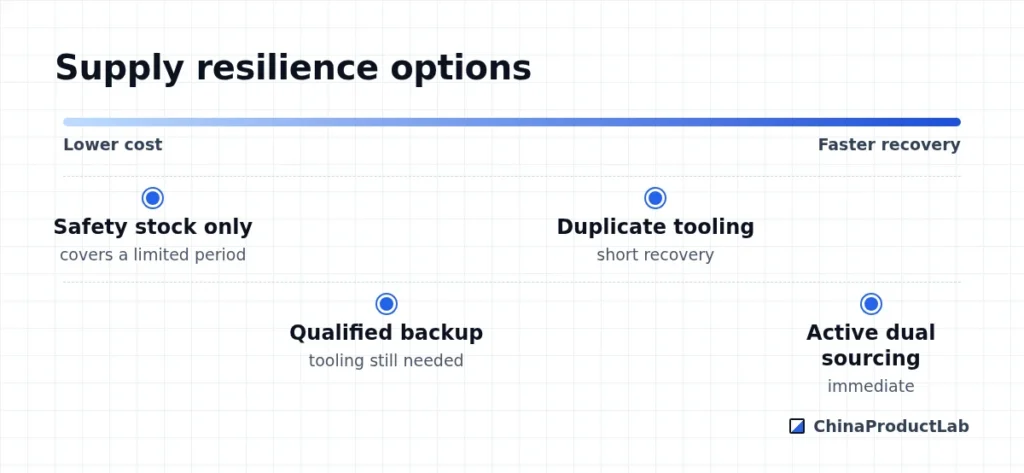
| Approach | Cost | Recovery time |
|---|---|---|
| Safety stock only | Inventory cost | Covers a limited period |
| Qualified backup, no tooling | Qualification effort | Tooling lead time if needed |
| Duplicate tooling at a second supplier | Second set of tools | Short |
| Active dual sourcing (split volume) | Tooling and management effort | Immediate |
Managing two suppliers
Once a second source exists, the challenge is keeping both aligned over time:
- Same drawings, specifications and inspection plans, distributed through one controlled process
- Comparable reports from both, so differences are visible early
- Parts from both suppliers tested together in assembly to check interchangeability
- Clear rules on which supplier gets which volumes, so neither is surprised
- Periodic sample orders to the backup to keep processes and tooling ready
Be transparent with suppliers about dual sourcing. Most established manufacturers accept it as a normal practice for important parts, especially when the volume split and expectations are clear. Hiding it usually damages trust when it comes out.
Hidden single points of failure
Even with two assembly suppliers, the supply chain can depend on one source further upstream. Typical hidden dependencies are:
- One tool or mold that both suppliers would need
- A single source for a custom component, such as a display, battery pack or special connector
- A sub-supplier used by both factories for plating, anodizing or PCB fabrication
- Firmware, test fixtures or programming files held by only one supplier
- Critical knowledge held by one engineer at the supplier
Map the supply chain for your most important parts down one or two levels, and identify where a single failure would stop production. Not every risk needs a second source; sometimes safety stock, duplicate fixtures or a documented process is enough. The goal is to know where you are exposed and to make a conscious decision about each risk.
Contract points for dual sourcing
Make sure contracts with both suppliers support the strategy: tooling ownership in your name, the right to share drawings and specifications with other qualified suppliers, clear quality and change-notification requirements, and a reasonable notice period for volume changes. These clauses are easy to agree at the start of a relationship and difficult to add later, when a supply problem has already begun.
What makes it work
- A complete technical package: drawings, 3D files, specifications, inspection plan, packaging.
- Golden samples so both suppliers match the same reference.
- Full first-article approval at the second source.
- Same revision control — every ECN goes to both suppliers.
- Regular orders so the backup stays ready.
Related: choosing a manufacturing partner, mold ownership and transfer and supplier audits.