Photos on a website and a certificate in an email say little about how a factory works on a Tuesday afternoon. An on-site (or live video) audit shows whether the supplier can actually make your part, control quality and deliver — before you pay for tooling.
Audit checklist
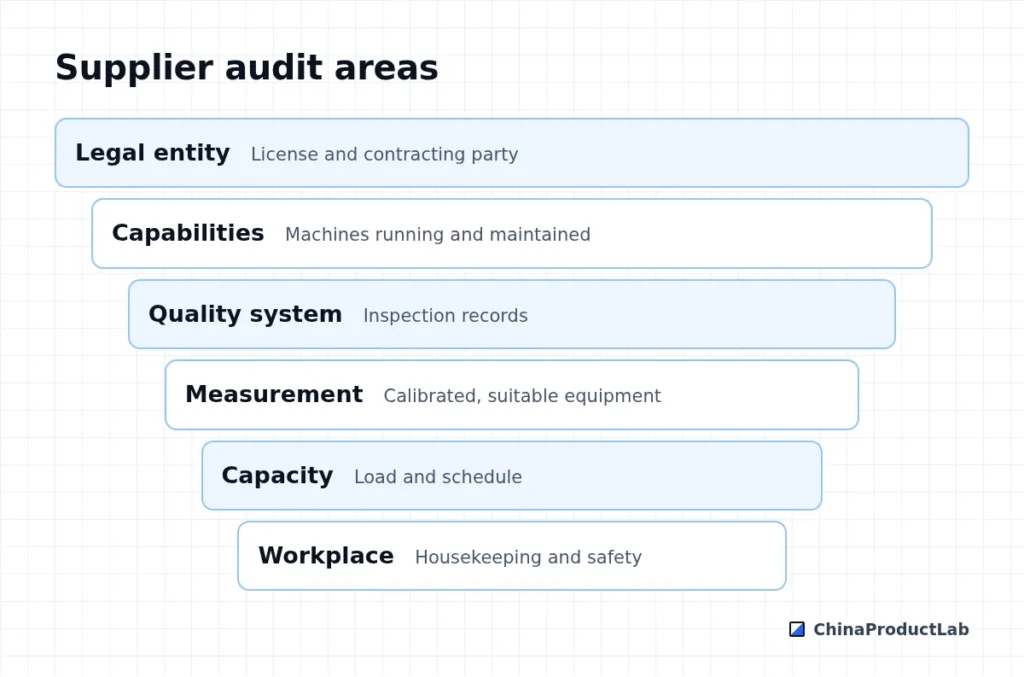
| Area | What to check |
|---|---|
| Legal entity | Business license, registered scope, the company you will sign with is the one you are visiting |
| Capabilities | Machines that match your process and part size; are they running and maintained? |
| Subcontracting | Which steps are outsourced (finishing, heat treatment, PCB fabrication) and how they are controlled |
| Quality system | Incoming, in-process and final inspection; records you can see; nonconforming material handling |
| Measurement | Equipment suitable for your tolerances; calibration labels and records |
| Engineering | Who reviews drawings, handles DFM and changes; document control |
| Capacity and schedule | Current load, shifts, how your volume fits |
| Workplace | Housekeeping, safety, working conditions — also a predictor of quality |
Red flags
- The “factory” is an office; production is elsewhere and not shown
- Equipment on the brochure is not on the floor
- No inspection records, or records filled in identically
- Calibration labels expired or missing
- Nobody can explain how a recent defect was handled
- Reluctance to let you see the production area
Remote and on-site options
An audit does not always require a flight. Choose the depth based on risk:
- Desk review — documents, certificates, sample parts, references; useful as a first filter
- Live video audit — a guided walk through the production floor, warehouse and quality lab in real time
- On-site audit — by your team or a third-party auditor; best for new suppliers of critical parts
- Process audit — focused on one product line during actual production of your parts
Ask to see things rather than hear about them: an open inspection record from this week, the calibration certificate of the gauge used on your part, the handling of a recent customer complaint. Note the date and name of the person you spoke with — follow-up becomes much easier when findings are specific.
Scoring and follow-up
A simple scoring sheet turns audit impressions into a decision. Rate each area — for example quality system, engineering, process capability, capacity, workplace — on a short scale, and mark any finding that would block approval on its own, such as no incoming inspection for critical materials or undisclosed subcontracting of key processes.
Share the findings with the supplier and agree which ones must be corrected before the first order and which can be improved over time. Ask for evidence of the corrections, such as photos, revised procedures or new records. Plan a follow-up visit or video check after the first production run, because that is where the system is tested with your actual parts. Over time, the audit history becomes valuable when deciding which suppliers to grow with and which to replace.
After the audit
Write findings down, agree corrective actions with dates, and confirm with a sample order. Audits complement — not replace — sample approval and inspection. See how to choose a manufacturing partner and quality control in China, or read how we work with suppliers.