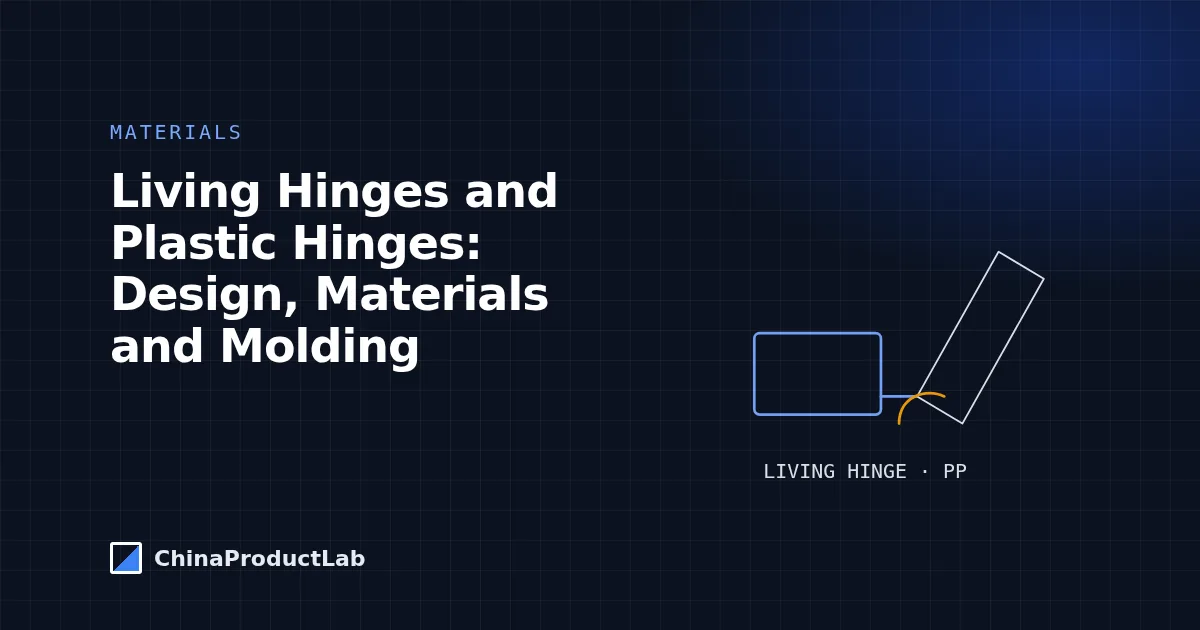
Flip-top caps, cable clips and storage boxes often use a living hinge — a thin, flexible section of plastic that connects two parts molded as one. Done well, it survives a very large number of openings at almost no cost. Done badly, it cracks within days. The difference lies in the material, the geometry and how the part is molded.
Material choice
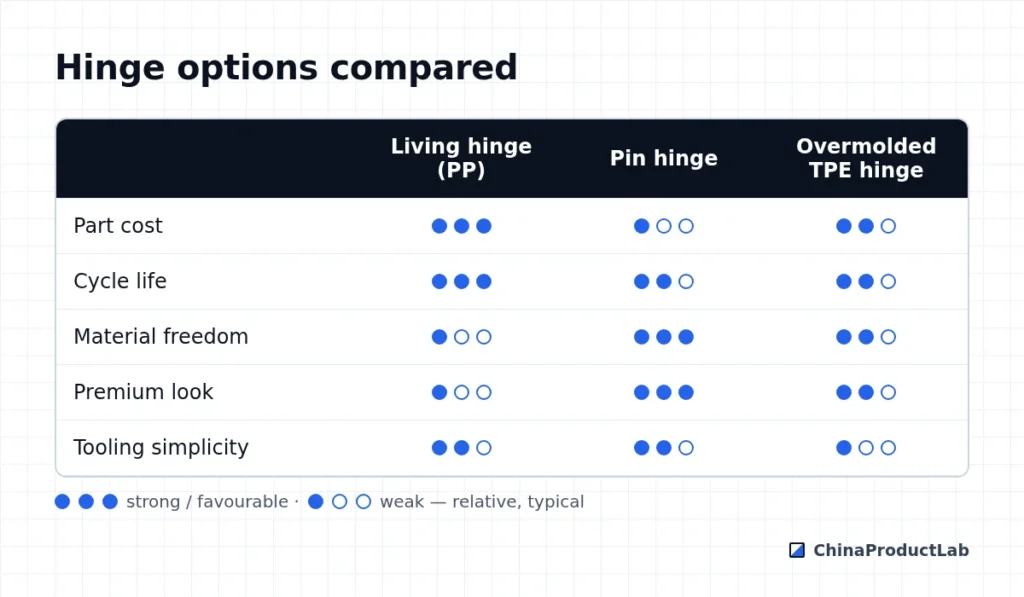
Polypropylene (PP) and polyethylene are the classic living-hinge materials because their molecular structure orients during flexing and resists fatigue. Most other common plastics — ABS, PC, PS — are too brittle for a true living hinge and need a pin hinge, a separate hinge part or an overmolded flexible section.
Design guidelines (typical)
- Thin, uniform hinge section; the resin supplier’s guidance gives the range for the grade
- Generous radii on both sides of the hinge to avoid stress concentration
- Hinge length long enough to spread bending
- A shoulder or recess so the hinge does not see sharp bending at the edge
- Hinge line straight and perpendicular to the flow direction across it
- Clearance so the closed parts do not crush the hinge
Molding matters as much as design
Plastic should flow across the hinge in one direction, not meet inside it — a weld line in the hinge will fail. This usually means gating on one side so that the melt fills one half, crosses the hinge and fills the other half. Many molders flex the hinge several times right after ejection while it is still warm; this orients the material and greatly improves durability. Agree this step with the supplier and include it in the work instructions.
Typical applications and pitfalls
Living hinges are common in packaging closures, cable clips, tool cases, battery doors and pet-product lids. The most frequent problems are hinges that crack in cold weather, hinges that whiten and weaken after a few cycles, and lids that do not stay open or closed. Each points to a different fix: cold cracking suggests a grade with better low-temperature impact; whitening suggests the hinge is too thick or too short; poor open/close behavior suggests adding a detent or snap rather than relying on the hinge itself.
Ask your molder to share examples of living hinges they produce in the chosen grade. Experienced molders often have proven hinge geometries and process settings they can adapt, which shortens the trial phase considerably. Include hinge requirements — cycle count, temperature range and opening angle — in the drawing notes so they are tested, not assumed.
Testing and alternatives
Test cycle life at room temperature and in the cold, where PP becomes more brittle. Check that the hinge closes to the right position and that the parts stay aligned. If the product needs ABS or PC for appearance or strength, design a pin hinge with molded knuckles, use a separate hinge component, or overmold a flexible TPE strip.
- Ask the molder about their living-hinge experience with your resin grade
- Request samples flexed and unflexed to compare
- Include hinge cycle testing in validation
Related: plastic materials, overmolding and molding design rules.