
T1 samples arrive with sink marks over every boss and a lid that rocks on the table. The supplier says “we will adjust the process”; two rounds later the problem is still there. Knowing whether a defect comes from the design, the mold or the process tells you which fix will actually work — and who pays for it.
Defects and their usual causes
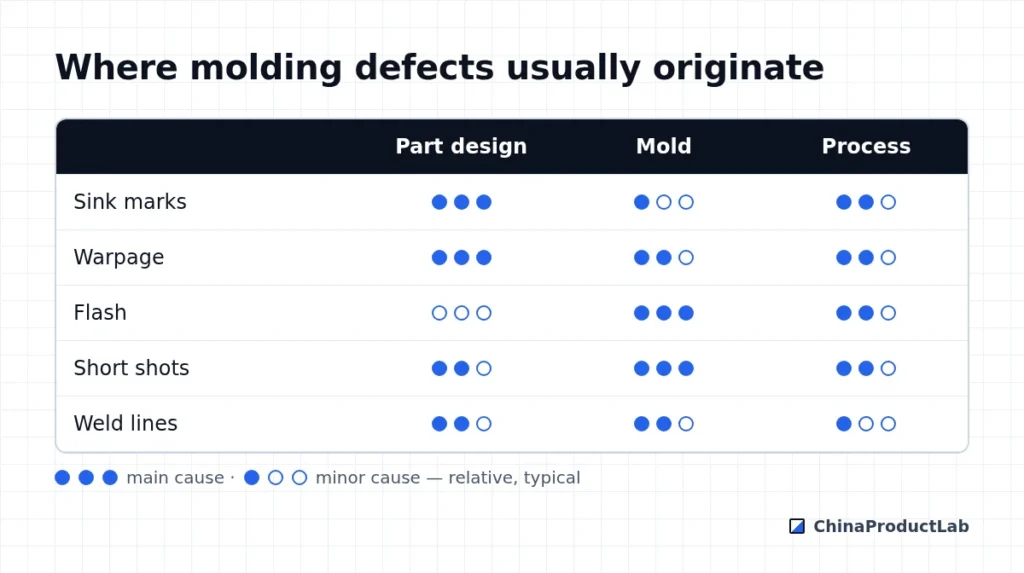
| Defect | What you see | Typical root cause | Where to fix |
|---|---|---|---|
| Sink marks | Shallow depressions over thick areas | Thick sections, bosses/ribs too thick relative to the wall | Design first (core out, thinner ribs); process can only reduce it |
| Warpage | Part bends or twists after ejection | Uneven walls, uneven cooling, fiber orientation | Design and mold cooling; process fine-tuning |
| Flash | Thin excess plastic at parting lines | Worn or poorly fitted shut-offs, low clamp force, excessive pressure | Mold repair; process |
| Short shot | Part not completely filled | Thin sections far from the gate, poor venting, low pressure | Gate location and venting; process |
| Weld / knit lines | Visible lines where flow fronts meet | Flow around holes and multiple gates | Gate position; design; texture can hide them |
| Burn marks | Dark spots at end of fill | Trapped air compressed and heated | Venting; injection speed |
| Flow marks / jetting | Wavy patterns, snake-like marks near the gate | Gate design, injection speed, melt temperature | Gate design; process |
How to work through a defect
- Photograph and mark the defect on several samples; note cavity number.
- Ask whether it appears on every shot or varies — consistent defects point to design/mold, varying ones to process.
- Review the area against design rules (wall thickness, rib ratio, draft).
- Agree the fix and its owner: design change (yours), mold modification (usually the toolmaker’s if the design was approved), or process window.
- Verify on the next trial with the same measurement method, then update the limit samples.
Questions to ask the molder
When samples show defects, these questions quickly separate process tuning from deeper issues:
- Does the defect appear in all cavities or only one?
- Was the resin dried according to the material supplier’s data sheet?
- What process changes were tried and what was their effect (with photos)?
- Did mold-flow analysis predict this area, and was it reviewed before tooling?
- Is the fix a mold modification, and if so, what exactly will be changed and when?
- How will the same defect be checked in production (visual standard, gauge, sampling)?
Avoid accepting “process window” fixes that leave no margin — for example, sink removed only by very long hold times. Such parts tend to drift back as the mold, material lot or machine changes. A sustainable fix keeps a comfortable process window.
Prevent instead of fix
- Run a DFM review and, for critical parts, a mold-flow analysis before steel is cut
- Keep walls uniform and ribs thinner than the wall they support
- Agree cosmetic standards and gate locations before tooling
- Use limit samples to define what is acceptable
Related: design for injection molding, DFM review checklist and golden and limit samples. Send us photos and the part file.