Many suppliers say “DFM done” after a quick look at your CAD. A real design-for-manufacturing review is different: it predicts the problems you would otherwise discover in T1 samples, failed assemblies or high unit costs — while changing the design still costs nothing but engineering time. Knowing what a thorough review contains lets you ask for one.
When to do it
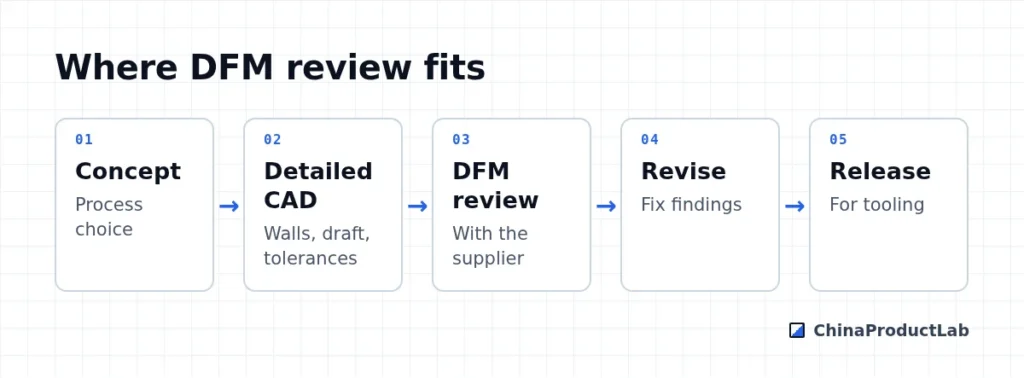
- Before final quotation — so the price reflects the design that will actually be made
- Before cutting tooling — the last cheap moment to change molded or cast parts
- Before PCB layout is frozen — DFM and DFT (design for test) for electronics
- Again after any significant design change
What the review should check, by process
| Process | Typical DFM checks |
|---|---|
| Injection molding | Wall thickness and transitions, draft, ribs and bosses, undercuts, gate location and weld lines, sink/warp risk, parting line, ejector marks on cosmetic faces |
| CNC machining | Tool access, internal radii, deep pockets, thin walls, number of setups, tolerances that drive cost, thread specifications |
| Sheet metal | Bend radius and relief, flange length, hole-to-bend distance, hardware placement, weld distortion, flat-pattern feasibility |
| PCB assembly | Component availability, footprints and spacing, polarity marks, thermal relief, test points, panelisation, programming access |
| Assembly | Tolerance stack-ups, assembly sequence, fasteners count and type, fixtures, cable routing, serviceability |
Process-specific rules are in our guides to injection molding design, CNC tolerances and sheet metal design.
What a useful DFM report looks like
- An issue list, each item with a screenshot or marked-up drawing
- Severity: must-fix (cannot be made / will fail), should-fix (yield, cost, cosmetics), optional (nice to have)
- A proposed change for each issue, not only the problem
- Cost or lead-time impact where relevant
- For molded parts: gate location, parting line and ejector positions shown on the part; mold-flow results for critical parts
- Open questions the supplier needs you to answer
Questions to ask your supplier
- Which features drive most of the cost — and what would change if we relaxed them?
- Where will gates, parting lines and ejector marks be, and are any on cosmetic surfaces?
- Which dimensions do you consider hard to hold, and how will you measure them?
- Which components or materials have long lead times or single sources?
- What would you change if this were your product?
Acting on the findings
Decide each item in writing, update the CAD and drawing revision, and ask the supplier to confirm that the next quote and tooling are based on the new revision. Track open items to closure before releasing tooling — a DFM report that nobody closes out is just a list of future problems.
DFM is part of our product development work. Send your CAD files for a review before you commit to tooling.