Enclosures of mains-powered and many battery-powered products must resist ignition and stop burning when a flame is removed. Safety standards for electrical products often require plastics with a specific UL 94 rating — and the rating applies to a specific resin grade, at a specific thickness, in a specific color range. Getting this wrong can stop certification late in a project.
Which rating is required depends on the product safety standard and the part’s function. Confirm requirements with your test lab or certification body.
UL 94 ratings in brief
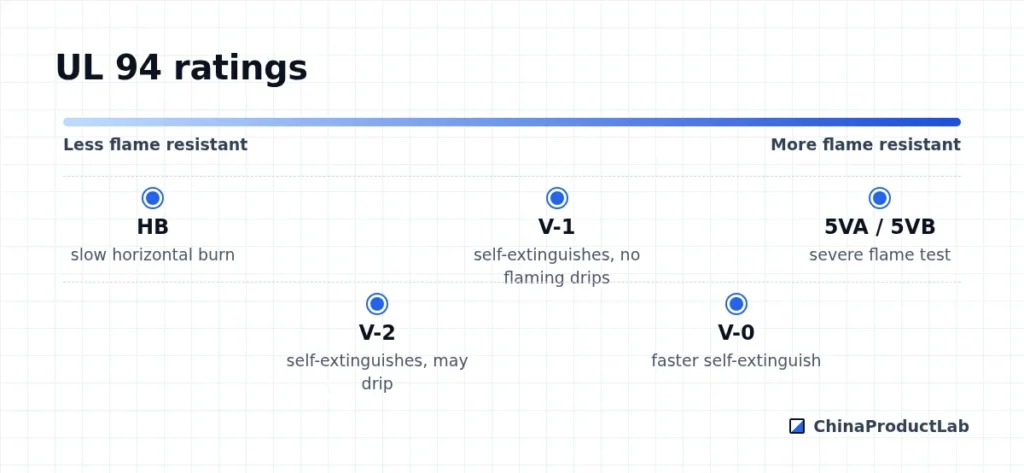
| Rating | Test summary |
|---|---|
| HB | Horizontal specimen burns slowly below a defined rate |
| V-2 | Vertical specimen stops burning within limits; flaming drips allowed |
| V-1 | Stops burning within limits; no flaming drips |
| V-0 | Stops burning faster than V-1; no flaming drips |
| 5VB / 5VA | Withstands a larger flame; 5VA without burn-through of plaques |
Thickness, color and listings
- A rating holds at or above the thickness listed — thinner walls may not qualify
- Some ratings apply only to certain colors; pigments can change performance
- Check the listing in the UL Product iQ database (or equivalent) for the exact grade
- Regrind and recycled content may affect the rating — agree limits
- Substitute grades must have their own listing, not just similar data
- Keep the resin supplier’s certificates for each lot in the technical file
Effects on design and production
Flame-retardant grades usually cost more, can be more brittle, may have lower impact strength and can show more visible flow lines. Some are more sensitive to drying and processing temperature. Design snaps and bosses with the actual grade’s properties, and test impact and drop performance on molded parts. If a product mixes rated and unrated plastics, the drawings must make clear which parts need which rating.
Questions for the molder and resin supplier
- Is the proposed grade listed at our wall thickness and in our color?
- Do you have a UL file or listing number for the grade?
- How do you store, dry and track lots of flame-retardant resin?
- Will you use regrind, and does the listing allow it?
- What happens if the grade becomes unavailable — which alternatives are listed?
Keep the answers with the technical file. Certification bodies often check that the materials in production match those in the certified design, and a silent resin substitution can invalidate certification. Including the exact grade on drawings, along with approved alternatives, protects both you and the molder.
Remember that ratings describe material tests, not product safety as a whole. The product standard defines which parts need which rating, and the full product is assessed in its own tests.
Practical steps
- Identify required ratings from the applicable safety standard with your lab.
- Choose grades that are listed at your wall thickness and color.
- Name the exact grade on the drawing, with approved alternatives.
- Require lot certificates from the molder and forbid unapproved substitutions.
- Re-check the rating when changing color, thickness or supplier.
Related: enclosure plastics, compliance documents and certification overview.