Machining a long enclosure from a solid block removes most of the material you paid for. An extruded profile delivers the cross-section — including heat-sink fins, screw channels and slots — for a fraction of the machining time. A custom extrusion die is usually a modest investment compared with molds.
Options
| Option | When it fits |
|---|---|
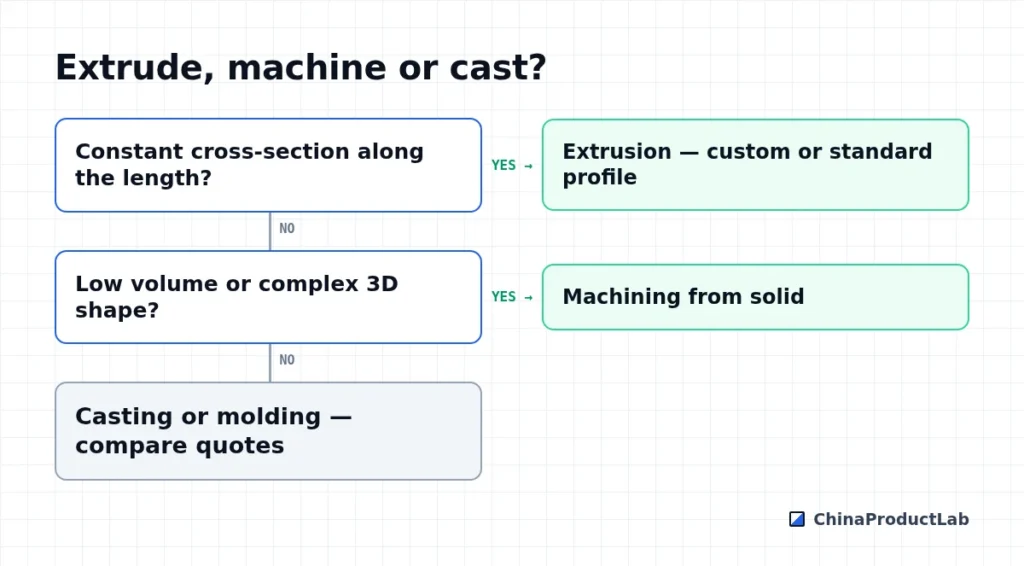
| Standard profile (T-slot, tube, angle) | Frames, fixtures, early prototypes; no die cost |
| Custom extrusion | Enclosures and parts with a constant cross-section; combines features into one profile |
| Machining from solid | Low volumes, complex 3D shapes, or tight tolerances everywhere |
Profile design rules (typical)
- Keep wall thickness as uniform as possible
- Avoid very thin walls next to thick sections
- Generous radii; sharp internal corners stress the die
- Hollow profiles cost more than open ones
- Integrate screw bosses (screw ports), slots for PCBs and snap features
- Choose a common alloy such as 6063 (good finish) or 6061 (stronger)
- Agree tolerances with the extruder — extrusion tolerances follow standards such as EN 755-9
Cost and supply questions
- Die cost and who owns the die
- Minimum order quantity per run (often defined by weight)
- Standard lengths and the cutting loss for your part length
- Tolerances the extruder can hold on critical features, and straightness and twist limits
- Who performs cutting, machining and anodizing — one supplier or several
- How cosmetic surfaces are protected during handling and machining
Extrusion runs often have a minimum weight, so small projects may buy more material than needed for the first order. That can still be economical if the profile is used across several products or future batches. For prototypes, machine the profile shape from solid or use a similar standard profile until the design is stable.
Finishing and appearance
Extrusions show die lines along the length of the profile. For visible enclosure surfaces, specify the appearance standard and agree on a finishing step: brushing or bead blasting before anodizing gives a uniform look and hides minor die lines. The alloy affects the finish — 6063 usually anodizes more evenly than 6061, which matters for cosmetic parts.
Color variation between anodizing batches is normal, especially for dark or saturated colors. If several extruded parts appear side by side, ask for parts to be anodized in the same batch, or define acceptable color limits with samples. Machined openings should be done before anodizing to protect the finish, while threads and contact areas may need masking. Plan for handling damage: protective film or separators between profiles during transport reduce scratches that would otherwise be rejected at inspection.
Combining processes
Extrusions combine well with other processes: sheet-metal brackets inside, molded end caps with gaskets, or die-cast covers at volume. Designing the profile as the backbone of the product often reduces part count and cost.
Turning a profile into a part
Cut to length, then machine openings, holes and threads; add end caps (machined, die-cast or molded). Anodizing extrusions gives a durable, uniform finish — define color and appearance with samples.
Related: die casting vs CNC, aluminum finishes and thermal design. Send your enclosure.