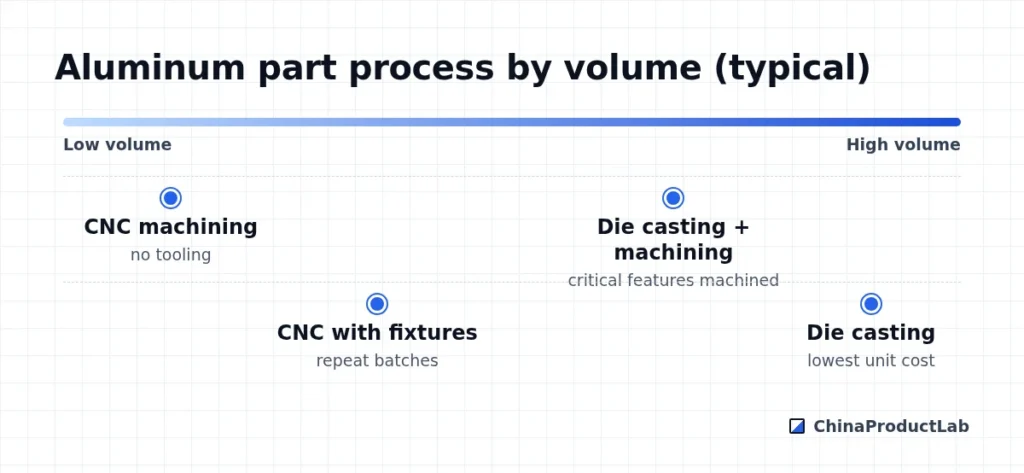
A machined aluminum housing is perfect for 50 units — and painful at 20,000, when every part still needs hours of machine time. Die casting can bring the unit cost down sharply, but it needs a die, a different design and different expectations about material and finish. The question is not which process is better, but at what volume and with which design changes the switch pays off.
Side by side
| Factor | CNC machining | Die casting |
|---|---|---|
| Tooling | None (fixtures only) | Steel die — significant one-time cost and weeks to make |
| Unit cost | Driven by machining time; stays relatively flat with volume | Low per part once the die exists |
| Typical alloys | 6061, 7075 and other wrought alloys | Casting alloys such as A380 / ADC12 |
| Tolerances | Tight, consistent | Looser as-cast; critical features are machined afterwards |
| Internal quality | Solid wrought material | Some porosity is normal; matters for pressure-tight or highly stressed parts |
| Finishing | Anodizes well | Anodizing is limited by silicon-rich alloys; powder coat or paint is common |
| Design changes | Easy — change the program | Expensive — modify the die |
Designing for die casting
- Uniform walls (thick sections cause porosity and shrinkage)
- Draft on walls in the die opening direction
- Generous radii and ribs instead of thick blocks
- Bosses cored out and connected with ribs
- Machining allowance only where precise features are needed
- Gate and overflow locations away from cosmetic faces
Questions to ask before switching
A die-casting quote is only comparable to a machining quote when it covers the whole route. Ask each supplier to break the cast part down so you can see where the cost really sits:
- Die cost, number of cavities and expected die life in shots
- Trimming, deburring and secondary machining per part — and who does it
- Which features are as-cast and which are machined, marked on the drawing
- Porosity acceptance criteria and how they are checked (sectioning, X-ray, leak test)
- Surface finish options for the chosen alloy and how cosmetic faces are protected
- Lead time to first samples and how many sample rounds are included
A common mistake is sending the machined design unchanged to a die caster. Sharp internal corners, deep pockets without draft and uneven walls that were free in machining become porosity, sticking and long cycle times in casting. Expect a redesign round, and budget time for it before the volume ramp, not during it.
A practical middle path
Some projects use both processes at once: a near-net-shape casting for the bulk of the part, followed by CNC machining of mating faces, bores and threads. This keeps tight tolerances where they matter while removing most of the machining time.
How to decide
- Estimate lifetime volume, not just the first order.
- Get quotes for both: CNC unit price vs. die cost plus cast-and-machine unit price.
- Check whether the casting alloy and its finish meet your requirements (strength, corrosion, appearance).
- Plan a bridge: keep machining while the die is made and samples are approved.
- Re-qualify the part after the switch — castings behave differently from machined parts.
Machining cost drivers are explained in CNC machining cost; material choice in aluminum vs steel vs stainless. Send your part and volumes to compare both routes.