Robots, actuators and motion products live or die by their motors. An undersized motor overheats, an oversized one wastes battery and money, and a noisy gearbox ruins the user experience. Motor choice also drives the electronics: drivers, encoders, power supply and firmware all follow from it.
Motor types compared
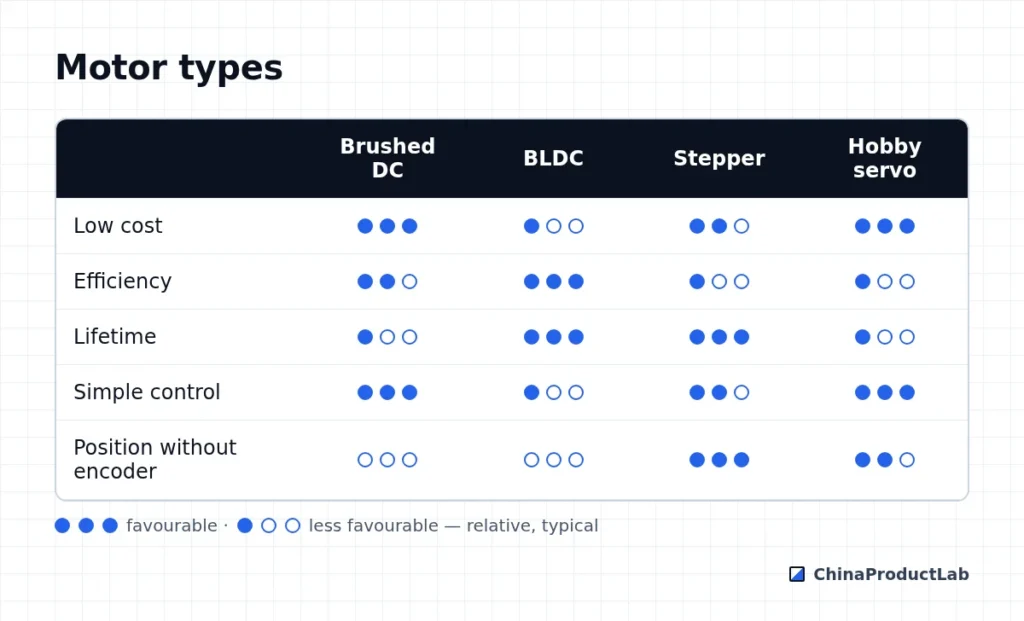
Sizing the motor
- Torque at the output, including friction, inertia and acceleration
- Speed range at the output, and the gear ratio
- Duty cycle — continuous vs short peaks (thermal limits)
- Supply voltage and available current (battery peaks)
- Feedback needed: none, hall sensors, incremental or absolute encoder
- Noise limits for indoor or consumer use
- Lifetime in hours or cycles
Check torque-speed curves rather than single values, and leave margin — motors running near their limits get hot, and heat shortens lifetime. Gearboxes multiply torque but add backlash, noise and wear; planetary gearboxes are compact, spur gearboxes are cheaper, and worm gears can hold position without power.
Sourcing considerations
| Topic | What to ask |
|---|---|
| Customisation | Shaft length, connector, cable, mounting — available at your volume? |
| Test data | Torque-speed curve, current, noise, life test results |
| Consistency | Variation between lots; incoming inspection |
| Lead time and MOQ | Especially for custom windings or gear ratios |
| Second source | Standard frame sizes ease alternatives |
Motor drivers and control
The motor and its driver work as a pair. Brushless motors need commutation, either with Hall sensors or sensorless algorithms; steppers need current control and benefit from microstepping for smoother, quieter motion; servos need tuned control loops. Choose a driver with enough current margin, protection features (over-current, over-temperature, stall detection) and support for the feedback you need.
Consider control early in mechanical design: a stiff mechanism with low backlash is easier to control accurately than a flexible one with play. For battery products, check how motor current peaks affect the battery and other electronics — inrush currents can cause brown-outs and resets if the power design does not account for them.
Incoming inspection for motors
Motors vary between lots more than many components. A practical incoming check includes no-load current and speed at rated voltage, noise in a quiet room, shaft play and visual inspection of connectors and leads. For gearmotors, add backlash and output torque checks on samples. Track results by lot; drift in no-load current or noise can indicate changes in magnets, windings or lubrication before they become field failures.
Documentation to request
Ask motor suppliers for a full datasheet with torque-speed and efficiency curves, a mechanical drawing with tolerances, insulation class, life test conditions and results, and declarations for restricted substances. Keep these with your design records; they are needed for certification and when qualifying alternatives.
Testing
Test motors in the real mechanism under realistic loads and temperatures, and run life tests on several units. Measure current and temperature at worst-case operation. For products with many motors, check how motor noise affects EMC.
Related: robotics parts, EMC pre-compliance and robotics industry.