Failing an EMC test at the accredited lab is expensive: the product goes back to engineering, sometimes with a board respin, and the lab slot must be rebooked. Pre-compliance testing — quick, approximate measurements early in development — finds most emission and immunity problems while they are still cheap to fix.
Pre-compliance results are indicative. Final compliance must be demonstrated by testing to the applicable standards, usually at an accredited lab.
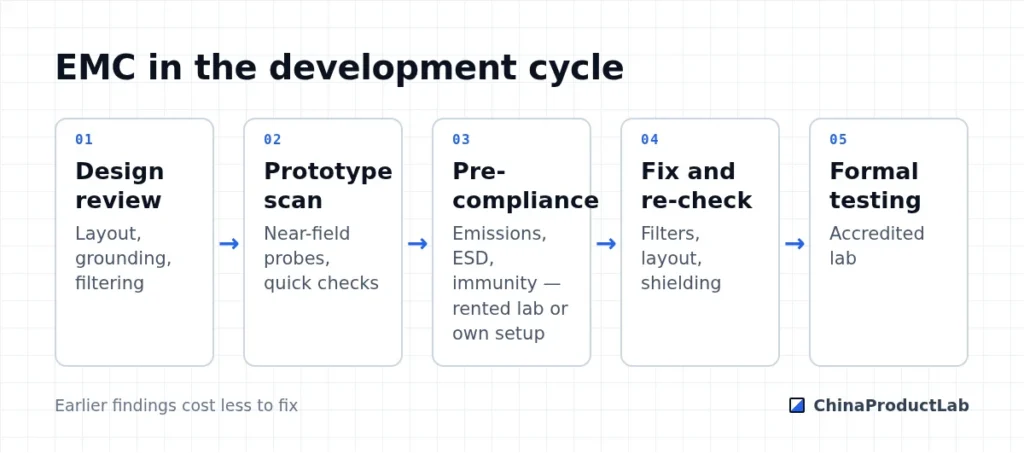
Where it fits
What to test early
| Test | Finds | Typical setup |
|---|---|---|
| Radiated emissions | Noise from clocks, switching regulators, cables | Pre-scan at a test house or near-field probes + spectrum analyzer |
| Conducted emissions | Noise on power cables | LISN + spectrum analyzer |
| ESD | Resets, damage from static discharge | ESD gun on touch points and seams |
| Radiated / conducted immunity | Malfunction under RF fields | Usually at a test house |
Common fixes
- Solid ground planes and short return paths in the layout
- Filtering at cable entries (ferrites, common-mode chokes, capacitors)
- Slower edges and spread spectrum on clocks where possible
- Shielding cans over noisy circuits
- Shorter, better-routed internal cables
- ESD protection devices at connectors and exposed contacts
Test with the final enclosure, cables and power supply — external adapters and long cables often dominate emissions. Keep notes of each configuration, so the formal test uses exactly the setup that passed pre-compliance.
Budget and schedule
Pre-compliance testing costs a fraction of a formal test campaign and failed retests. Typical approaches include renting a few hours at a test house for pre-scans, or building a simple in-house setup with near-field probes, a spectrum analyzer and a LISN. Even basic measurements reveal the frequencies that are likely to fail, so engineers can focus their fixes.
Plan at least one pre-compliance round on the prototype that is closest to production — with the final enclosure, cables and power supply — and leave time for one round of fixes. Board changes take weeks; adding a ferrite or changing a filter value takes days. The earlier a problem is found, the more fix options remain.
Documentation for the lab
Prepare a short test description for the accredited lab: product description and variants, operating modes to test, cable types and lengths, power supply, and how the lab can see that the product works correctly during immunity tests. Clear pass/fail criteria for immunity — for example “no reset, data continues” — avoid discussions during testing. Good preparation shortens lab time, which is usually billed by the hour or day.
Booking the formal test
Book the accredited lab when pre-compliance shows comfortable margins and the design is frozen. Bring spare units, firmware with test modes, cables and the power supply that will ship. Agree the test plan with the lab in advance so the right standards and operating modes are covered.
Related: certification overview, antennas in enclosures and electronics manufacturing.