For a new product, the first order is often limited by cash and uncertainty — while suppliers quote minimum order quantities (MOQs) that seem designed for established brands. MOQs are rarely arbitrary. Understanding what drives them helps you negotiate the ones that are flexible and plan around the ones that are not.
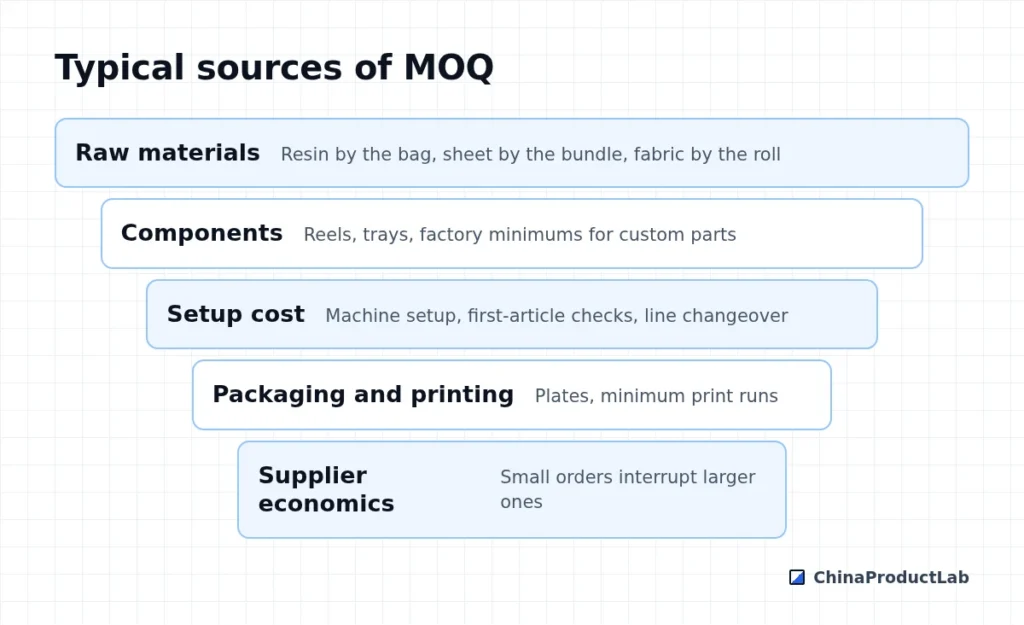
Where MOQs come from
Ways to lower the effective MOQ
| Driver | Approach |
|---|---|
| Material | Use standard colors and grades the supplier already stocks |
| Components | Choose parts available from distributors in cut tape; plan to use excess in later batches |
| Setup | Accept a higher unit price or a setup fee for a smaller batch |
| Packaging | Generic or digitally printed packaging for the first run |
| Supplier interest | Share the volume plan and commit to a schedule of releases |
Negotiating well
- Ask for a price break table at several quantities, not only the MOQ price
- Offer a blanket order with staged deliveries
- Agree that the MOQ applies per order, not per color or variant, where possible
- Separate one-time costs from unit cost in the quote
- Be realistic: very small orders cost more per unit
Some MOQs cannot be negotiated away — a reel of a specific chip, a bag of a special color resin. Then the question is whether excess material is a loss or inventory for the next batch. Including that inventory in the cost comparison often shows that a slightly larger first order is cheaper overall.
MOQs for electronic products
Electronic products often have the most complex MOQ structure, because each component has its own packaging unit and lead time. A board with a hundred components may contain a few that come only in full reels of thousands. Review the BOM with your assembler early to identify these, and look for alternatives that are available in smaller quantities from distributors.
Excess components are not always wasted: if the same parts are used across several products or future batches, they become inventory. Agree with the assembler who owns excess material, where it is stored and how it is used in later orders. Without that agreement, excess quietly becomes an extra cost on every order.
Communicating your plan
Suppliers are more flexible when they understand the opportunity. Share a realistic volume plan, your launch timeline and how you will grow. Small first orders with a credible path to larger ones are attractive to many manufacturers.
Pilot runs
A pilot run of a few hundred units, even at a higher unit price, tests the market, the production process and the packaging before a full order. Plan it explicitly with the supplier as a separate phase with its own price, rather than asking for “a small first order” at the full-volume price.
Related: small-batch manufacturing, comparing quotations and small-batch manufacturing services.