The logo looked perfect on the sample — after three months in a customer’s pocket it is half gone. Marking is often chosen at the last minute, but the method decides how long logos, ratings labels and button icons survive, and how consistent the color is from batch to batch.
Methods compared
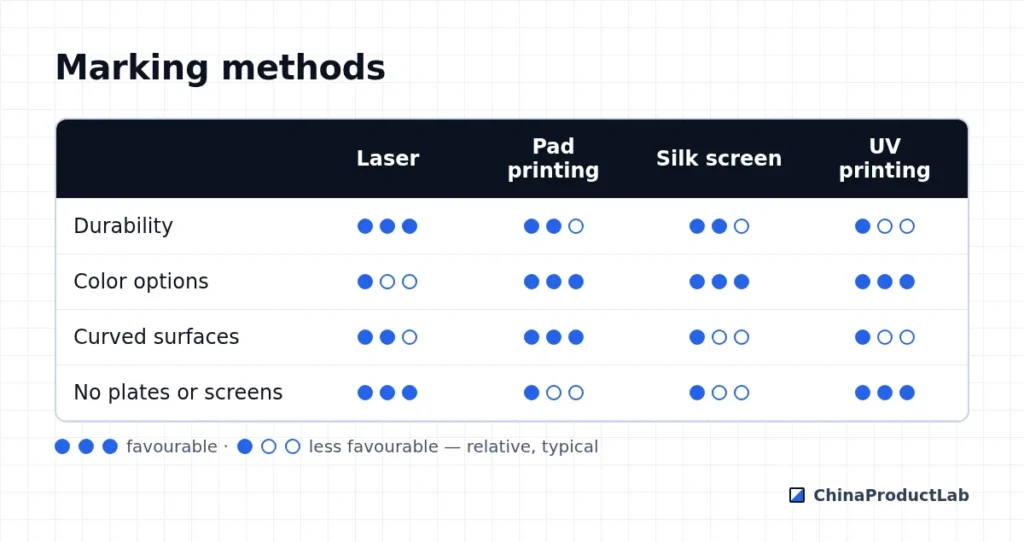
| Method | Works on | Strengths | Limits |
|---|---|---|---|
| Laser marking / engraving | Anodized aluminum, steel, many plastics | Very durable, no consumables, serial numbers and QR codes | Limited colors (contrast depends on material) |
| Pad printing | Curved and uneven plastic or metal surfaces | Fine detail, multiple colors | Ink adhesion depends on material and pre-treatment |
| Silk screen | Flat or simple curved surfaces | Opaque, vivid colors, larger areas | Less suited to complex shapes |
| UV digital printing | Flat surfaces, short runs | Full color, no screens or plates | Durability varies; may need a protective coat |
| Molded-in text / texture | Molded parts | Permanent, no extra step | Change requires mold modification; low contrast |
Specifying marking
- Artwork as vector files with exact size and position on the drawing
- Color reference (Pantone) and a physical approved sample
- Durability test: e.g. rub test with defined cycles, tape adhesion test, alcohol or sweat resistance
- Placement tolerance
- Which marks are regulatory (ratings, compliance marks, serials) and must be permanent
Questions to ask before approving marking
- Which method and ink or laser parameters will be used on each surface?
- Is pre-treatment needed (flame, plasma, primer) and is it part of the process?
- What durability tests are run, and how often in production?
- How is position checked — fixture, visual template, vision system?
- How are serial numbers or QR codes generated, verified and logged?
Regulatory markings deserve special attention: rating labels, compliance marks and serial numbers usually must remain legible for the product’s life. Verify their durability with the relevant product standard or your test lab, and do not rely on decorative print methods for them without testing.
Cost and setup
Each method has a different cost structure. Pad printing and silk screen require plates or screens and fixtures for each design and color; the setup is affordable but every artwork change means new plates. Laser marking needs only a digital file and a fixture, so changing artwork or adding serial numbers costs little, but cycle time per part can be longer for large areas.
Multi-color logos multiply printing steps and alignment problems; laser marking usually produces only one tone. If your brand guidelines require exact colors, test early on production materials — the same ink looks different on black ABS and white PC. For products in several color variants, check that the marking stays legible on each. Simple decisions, such as placing the logo on a flat surface rather than a curved edge, can reduce cost and improve consistency throughout production.
Tips
Laser marking works especially well on anodized aluminum. On plastics, ask whether a laser-markable grade is needed. Pad printing on low-surface-energy plastics like PP may need flame or plasma treatment.
Related: aluminum finishes, golden samples and injection molding.