The wireless technology shapes almost everything about a connected product: battery size, antenna, enclosure, app design, certification, monthly costs and how customers set it up. Changing it late is effectively a redesign. The right choice starts from where the product is used, how much data it sends and how long the battery must last.
Technologies compared
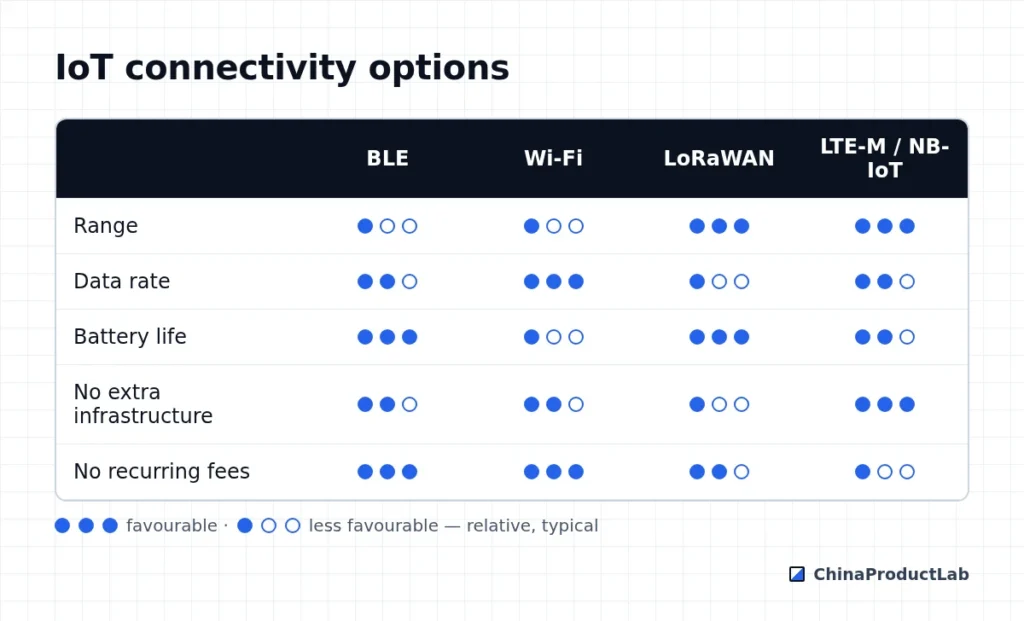
| Technology | Typical fit |
|---|---|
| Bluetooth LE | Wearables, phone-connected devices, short range, low power |
| Wi-Fi | Mains-powered home devices, cameras, higher data |
| LoRaWAN | Sensors sending small data over long range, multi-year battery; needs gateways or network |
| LTE-M / NB-IoT | Devices anywhere with coverage, trackers; SIM and data plan |
Questions that decide
- Where is the device — home, factory, field, moving?
- Is there a phone, router or gateway nearby?
- How much data, how often? Is real-time needed?
- Battery or mains powered; required battery life?
- Who pays recurring connectivity costs over the product life?
- Which markets — bands and network availability differ by region
- How will customers set it up, and how will support handle failures?
Hardware implications
Each technology brings hardware consequences: antenna size and placement, battery capacity for peak transmit currents, SIM or eSIM for cellular, and certification scope. Pre-certified modules reduce radio certification work and are often the practical choice for small and medium volumes, at a higher unit cost than a chip-down design. Combination products (e.g. BLE for setup and Wi-Fi for data) are common but add complexity.
Total cost of connectivity
Compare connectivity options over the product life, not just the module price. Cellular adds SIM and data plan costs for every device, often for years. LoRaWAN may need gateways or a network subscription. Wi-Fi and BLE avoid recurring fees but depend on customer infrastructure and phone apps, which raises support effort. Battery size and replacement also differ greatly between technologies.
| Cost item | Examples |
|---|---|
| Hardware | Module or chip, antenna, larger battery |
| Certification | Radio testing, carrier approvals for cellular |
| Recurring | Data plans, network subscriptions, cloud services |
| Support | Setup help, connectivity troubleshooting, app maintenance |
Regional differences
Frequency bands and network availability differ by region. LoRaWAN uses different frequency plans in Europe, North America and Asia; cellular LTE-M and NB-IoT coverage varies by country and operator; Wi-Fi channels differ slightly. If you sell internationally, choose modules that support the needed bands, and check roaming and carrier certification requirements for cellular products early in the project.
Setup experience
Connectivity also determines the first minutes of the customer experience. Wi-Fi products need a pairing flow to enter network credentials; BLE products depend on the phone app; cellular products can work out of the box but need activation. Test the setup with real users who did not build the product, and count how many succeed without help.
Prototype before committing
Test with development kits in the real environment — the basement, the barn, the factory floor — not only at the office. Measure range, battery consumption over realistic duty cycles, and connection reliability. Those tests decide more than any datasheet.
Related: antennas in enclosures, IoT hardware to production and IoT hardware. Discuss your connected product.