
Two mold quotes for the same part can differ greatly in price — and one of the main reasons is often the runner system. A hot runner keeps plastic molten all the way to the part; a cold runner lets it solidify in channels that are ejected with every shot. The choice affects tool cost, part cost, waste, gate appearance and maintenance for the life of the mold.
Compared
| Factor | Cold runner | Hot runner |
|---|---|---|
| Tool cost | Lower | Higher (manifold, nozzles, controller) |
| Material waste | Runner per shot — scrap or regrind | Little or none |
| Cycle time | Runner must cool too | Often shorter |
| Gate mark | Depends on gate type; often trimmed | Small; valve gates give very clean marks |
| Color / material changes | Easy | Slower — manifold must be purged |
| Maintenance | Simple | Heaters, thermocouples, controller |
| Heat-sensitive materials | Fewer issues | Residence time must be managed |
Which one?
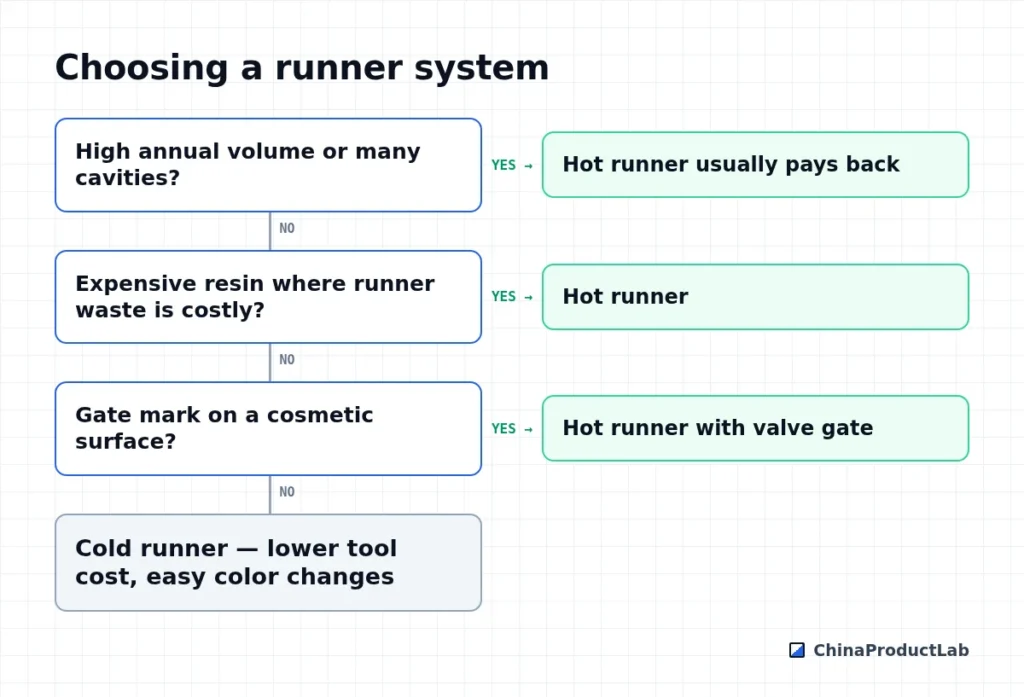
Between the two are semi-hot designs: a hot sprue or manifold feeding short cold sub-runners. They reduce waste and cycle time compared with a full cold runner at a lower cost than a full hot system.
Gate types in brief
- Edge / tab gate (cold) — simple, needs trimming, visible mark on the edge
- Submarine / tunnel gate (cold) — breaks off automatically during ejection
- Pin-point gate (three-plate cold) — small mark on top surface
- Hot tip — small vestige, may leave a slight bump
- Valve gate (hot) — mechanically closed, cleanest mark, controls fill sequence
Maintenance and long-term cost
Hot runner systems need care: heater zones, thermocouples and nozzle tips wear or fail, and a failed zone can stop production. Ask whether the molder has experience with the proposed brand, keeps spare parts and can repair the system locally. Plan for the controller: some molders supply their own, others expect the controller to travel with the mold — clarify ownership before a mold transfer.
On the cold-runner side, decide whether regrind is acceptable. Using a controlled percentage of reground runners reduces waste, but it can affect color, mechanical properties and flammability ratings. For cosmetic or safety-relevant parts, many brand owners forbid regrind or limit it strictly, which changes the cost comparison. Make the decision explicit in the quotation and the quality agreement.
A note on startup and scrap
Hot runner molds need time to reach stable temperatures at every startup, and the first shots are often scrapped. For short production runs with frequent mold changes, this startup scrap and time can reduce the expected savings. Ask the molder how long their startup takes for your tool and how many parts are typically discarded, and include it in the cost comparison.
Questions for the toolmaker
- Which runner system and gate type is quoted, and why?
- Which hot runner brand, and are spare parts available locally?
- Who owns the hot-runner controller — is it part of the tool?
- What is the shot weight with and without runner?
- Is regrind allowed for this part and in what percentage?
When comparing quotes, make sure the runner system is the same — otherwise you are comparing different tools. See injection mold cost, comparing quotations and injection molding.