Shafts, gears, pins and wear plates often need to be hard where they contact other parts, yet tough enough not to crack. Heat treatment changes the steel’s structure to achieve this. It is usually done by specialist heat treaters, and it brings its own challenges: distortion, scale, sequence with machining, and verification. A clear specification prevents soft parts and cracked parts alike.
Main processes
| Process | Result | Typical parts |
|---|---|---|
| Through hardening + tempering | Hard and strong throughout | Pins, tools, high-load parts in suitable steels |
| Case hardening (carburising) | Hard surface, tough core | Gears, shafts in low-carbon alloy steels |
| Induction hardening | Local hard zones | Shaft journals, bearing seats |
| Nitriding | Hard thin surface, low distortion, low temperature | Precision parts, molds, guides |
| Stress relieving | Reduces internal stress, little hardness change | Welded or heavily machined parts before finishing |
Sequence with machining
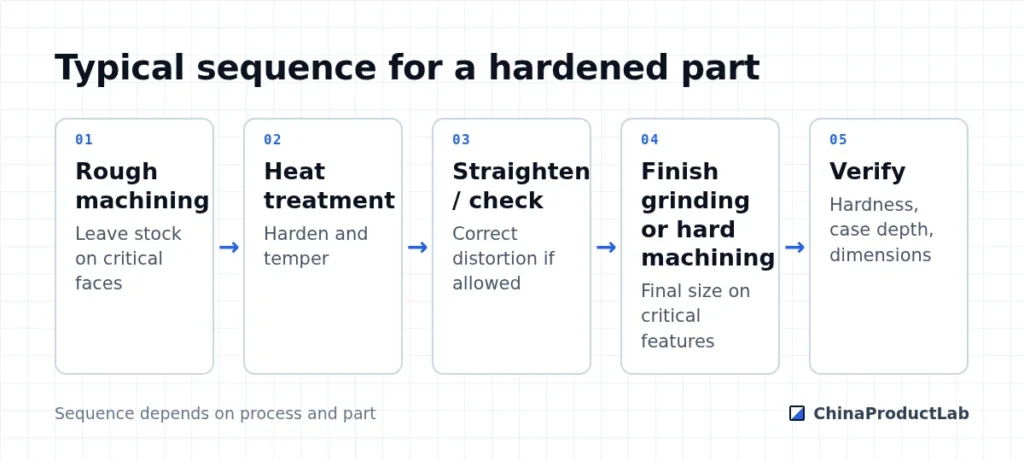
Heat treatment moves parts: long shafts bend, thin sections warp, bores shrink or grow. Critical dimensions are therefore usually finished after hardening, by grinding or hard turning. Nitriding, done at lower temperature, distorts less and is often the last step after finish machining.
Specifying heat treatment
- Steel grade by standard (e.g. EN, AISI or GB designation) — not only “carbon steel”
- Hardness with scale and range, e.g. 58–62 HRC
- Case depth and its definition for case-hardened or nitrided parts
- Zones to harden or protect (masking, induction areas)
- Core hardness where relevant
- Allowed distortion and straightening
- Test location and frequency; certificates per batch
Choosing the steel together with the treatment
The heat treatment and the steel grade must match. Through-hardening needs enough carbon and alloy content for the part’s cross-section; case hardening uses low-carbon alloy steels; nitriding works best with steels containing nitride-forming elements. Specifying a hardness that the chosen steel cannot reach is a common drawing error that only appears at the heat treater.
Ask your supplier or the heat treater to confirm the combination at quotation stage, including achievable hardness for your section thickness. For cross-border sourcing, compare equivalent steel grades carefully: nominal equivalents between standards can differ in composition and hardenability. Request mill certificates for the steel and heat-treatment certificates per batch, and keep both with the inspection records.
For parts with a long life or safety function, add a periodic destructive check — for example, sectioning one part per batch to measure case depth.
Verification
Ask for hardness test results on each batch, measured at a defined location. For case depth, a sectioned sample part or test coupon processed with the batch is common. Watch for decarburised (soft) surfaces after hardening without adequate protection, and for cracks at sharp corners — generous radii reduce cracking risk. Because heat treatment is typically subcontracted, ask your supplier which heat treater is used and how batches are traced.
Related: choosing metals, CNC cost drivers and robotics parts.