
When a plastic bracket flexes too much or creeps under load, the usual answer is “add glass fiber”. Glass-filled grades such as PA6-GF30 or PC-GF can be much stiffer and stronger than the base resin and keep their shape at higher temperatures. But glass changes how the part molds, shrinks, looks and fails — and those trade-offs need to be designed for.
Gains and costs
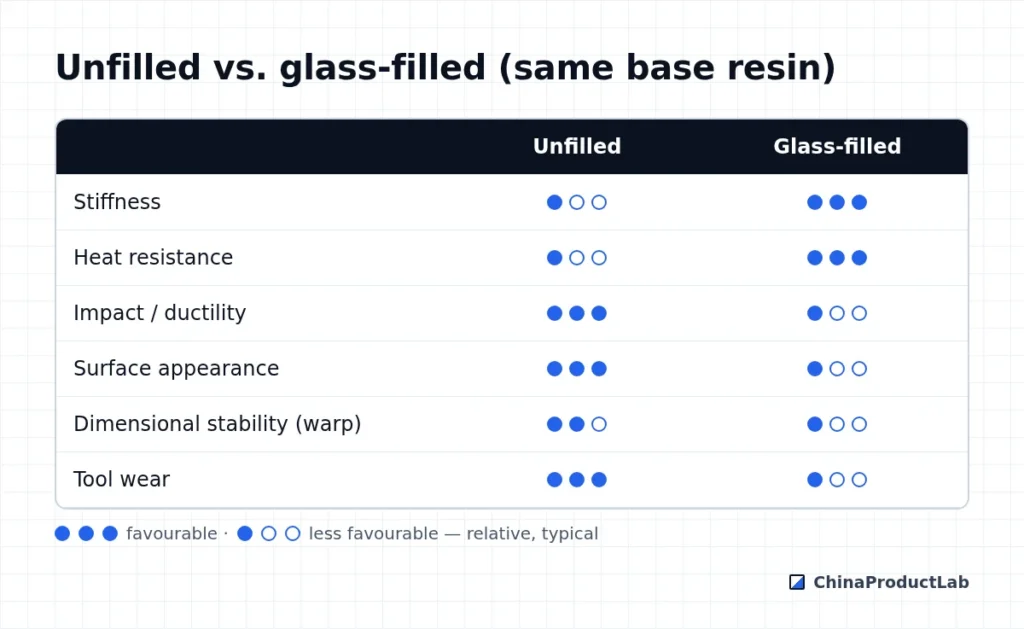
Design considerations
- Shrinkage differs along and across the flow direction — expect warpage on flat parts
- Weld lines are much weaker, because fibers do not cross them
- Snap fits have lower allowable strain — redesign rather than copy from unfilled versions
- Surface fibers can show; textures or a lower glass content help cosmetic parts
- Gate location controls fiber orientation and therefore strength direction
- Mold-flow analysis is valuable to predict warpage and fiber orientation
Tooling and production
Glass is abrasive: it wears gates, runners and cavities faster, so molds for glass-filled grades typically use harder, wear-resistant steels, and gate inserts may need replacement over the tool life. Nylon-based grades absorb moisture, which changes dimensions and properties — dry the resin before molding and test parts conditioned to realistic humidity. Regrind shortens fibers and lowers strength; agree regrind limits for structural parts.
Typical mistakes
- Switching to glass-filled resin without changing snap fits, so they break
- Placing the gate so fibers run across a loaded feature instead of along it
- Ignoring weld lines that fall on bosses or hinge points
- Expecting the same cosmetic quality as unfilled resin on visible surfaces
- Using the datasheet strength without accounting for moisture or temperature
- Forgetting that glass increases density, so parts get heavier
A good first step before choosing glass is to add ribs or change geometry: stiffness grows rapidly with section height, often providing the needed rigidity without changing material. When glass is necessary, run mold-flow analysis to place gates well, and test molded parts — not printed prototypes — under realistic loads and conditions.
Ask the resin supplier for data at different fiber contents and conditioning states, and choose the lowest glass content that meets the requirement. Higher glass levels increase stiffness further but worsen warpage, surface quality and tool wear.
Inspecting glass-filled parts
Inspection of glass-filled parts should include flatness and warpage on large flat areas, measured on a reference surface with defined support points. Check weld-line areas visually and, for structural parts, with pull or bending tests on samples from each new lot of material. Moisture content matters for nylon-based grades: agree how parts are conditioned before measurement, because dry-as-molded and conditioned parts differ in dimensions and toughness. Record the resin lot on each production batch so that problems can be traced to material or process.
Alternatives to consider
| Need | Alternatives |
|---|---|
| More stiffness | Ribs and geometry changes before changing material |
| Better surface with some stiffness | Mineral-filled grades, lower glass content |
| High stiffness and strength | Metal inserts or a metal part |
| Heat resistance | Higher-temperature base resins |
Related: plastic materials, molding design rules and robotics parts.