A product with a top cover, bottom cover and a battery door needs three molded parts. One option is three separate molds; another is a single family mold that makes all three in one shot. At higher volumes, a multi-cavity mold makes several copies of the same part per shot. Each layout trades tool cost against flexibility, quality and unit cost.
Layouts compared
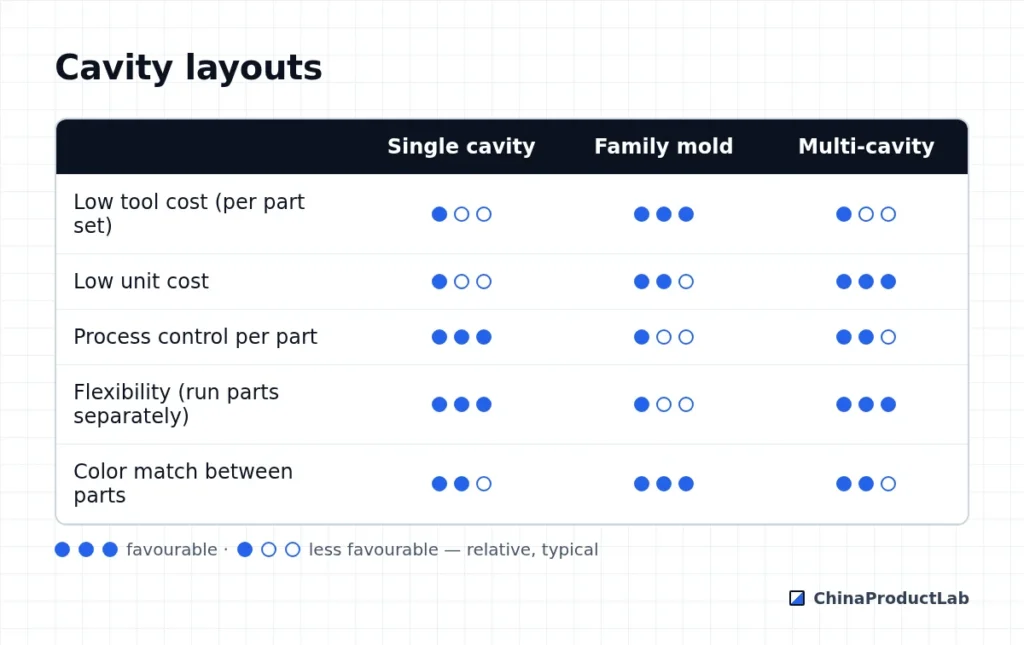
When family molds work
- Parts are similar in size, wall thickness and weight
- Same material and color
- Parts are needed in equal quantities
- Low to medium volumes where tool cost dominates
- Cosmetic parts that must match in color and gloss
Problems arise when parts differ greatly: a large thin cover and a small thick knob need different pressures and cooling times, so one part is always a compromise. If one part needs a design change, the whole tool goes back to the toolroom. Some toolmakers add shut-offs so individual cavities can be blocked, which helps with unequal demand but adds complexity.
Multi-cavity molds
Multi-cavity tools (2, 4, 8 or more cavities of the same part) lower the unit cost by sharing cycle time. They require balanced runners so all cavities fill equally, and each cavity should be numbered on the part so problems can be traced. Inspection must cover every cavity — an FAI on cavity 1 does not prove cavity 4.
| Decision factor | Points toward |
|---|---|
| Lifetime volume low, many different parts | Family mold or single cavity |
| One part with high volume | Multi-cavity |
| Design still changing | Single cavity (or bridge tooling) |
| Tight tolerances on different-size parts | Separate molds |
Planning for volume growth
Volumes rarely stay where the first forecast put them. A common strategy is to start with a single-cavity or family mold to keep investment low, then add a multi-cavity production mold once demand is proven. The first mold continues as a backup or for spare parts. If you expect this path, design the parts so that a multi-cavity layout is feasible later — consistent gating locations and no features that only work in one specific tool layout.
- Ask the toolmaker how many cavities the part could support in a later tool
- Keep the 3D data and mold design files so a second tool can be built quickly
- Use the same steel grade and texture references for both tools
- Plan a short qualification when the new tool arrives: FAI per cavity and comparison with golden samples
Cost example in words
Imagine a product with three small parts needed in equal numbers. Three separate molds cost the most upfront but give full control. One family mold costs less, but every change affects all parts.
Questions to ask
- How will the toolmaker balance filling between different parts?
- Can cavities be shut off if one part needs changes or has different demand?
- How is each cavity identified on the part?
- What is the cost difference against separate tools?
Related: mold cost explained, bridge tooling and runner systems.