Your afternoon question arrives at midnight in China; the answer comes back while you sleep — and a one-day misunderstanding becomes a week of delay. Most rework between buyers and suppliers is caused by ambiguity, not bad intent. Clear, written, visual communication fixes most of it.
Rules that prevent errors
- Requirements in writing, with drawings — not only in calls or voice messages
- Annotated photos and screenshots: arrows, dimensions, “OK / not OK” examples
- Short sentences, one topic per message, numbered questions
- Avoid idioms and ambiguous words (“ASAP”, “nice finish”)
- Units, dates (YYYY-MM-DD) and revision numbers in every request
- Ask the supplier to confirm back in their own words for important points
Use the time difference
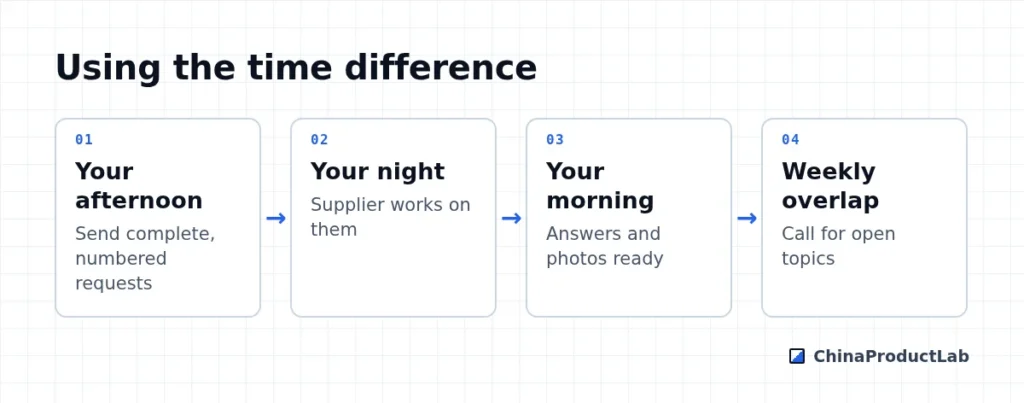
| Practice | Why it helps |
|---|---|
| Send complete requests before your end of day | The supplier works on them overnight (your time) |
| Weekly scheduled call in the overlapping hours | Resolve open questions in batch |
| Shared action list with owners and dates | Everyone sees status without chasing |
| Plan around Chinese public holidays | Avoid surprises in schedules |
Escalation and problem solving
Problems are easier to solve when everyone knows how to report them:
- Define who to contact for engineering, quality, production schedule and shipping
- Agree response times — e.g. acknowledgement within one working day
- Report problems with photos, quantities, batch and the requirement violated
- Ask for a root-cause analysis and corrective action with dates, not just “will improve”
- Escalate to management only after the normal path fails — and document it
Cultural differences matter too. Suppliers may avoid saying “no” or “we cannot” directly; ask open questions (“what risks do you see?”) rather than yes/no questions, and treat “we will try” as a signal to discuss details. A local partner who speaks both languages can close many gaps.
Meetings that produce decisions
Video calls are useful for complex topics, but only when they are prepared. Send an agenda with numbered topics and the drawings or photos one day in advance, so the supplier’s engineers can review them and bring the right people. During the call, share the screen and point at the exact feature being discussed instead of describing it.
End every call with a short written summary: decisions made, open questions, owners and dates. Send it within a few hours and ask the supplier to confirm or correct it. This takes a few minutes but avoids most “we understood differently” discussions later. For recurring projects, keep the same weekly time slot so both sides can plan, and cancel it when there is nothing to discuss rather than holding empty meetings. Consistency builds a reliable working rhythm across time zones.
One source of truth
Keep the current drawings, BOM and specifications in one controlled location and refer to revisions explicitly. Changes go through ECNs. Decisions made in chat are copied into the shared record.
Related: engineering change management, RFQ checklist and how we work.