
Smooth, precise motion depends on components most users never see: bearings, guides and screws. Choosing them affects accuracy, noise, lifetime and cost — and the machined parts around them must match their tolerance requirements. Many problems blamed on “bad bearings” are really mounting or lubrication problems.
Component overview
| Component | Typical use | Notes |
|---|---|---|
| Deep groove ball bearing | Shafts, wheels, pulleys | Versatile, standard sizes |
| Angular contact / crossed roller | Robot joints with combined loads | Preload and stiffness matter |
| Plain bushing | Low speed, low cost, oscillating motion | Polymer or bronze; no rolling elements |
| Linear guide rail | Precise linear motion with load | Accuracy class and preload |
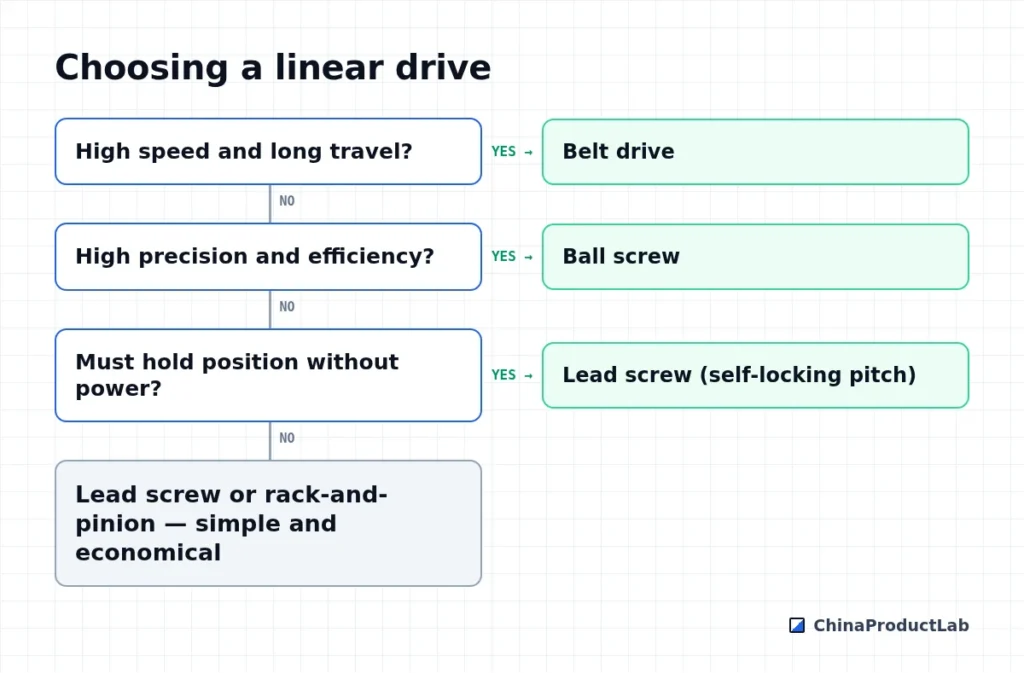
| Lead screw | Low-cost linear drive | Lower efficiency; can self-lock |
| Ball screw | Efficient, precise linear drive | Higher cost; needs a brake when vertical |
Choosing a linear drive
Design and mounting
- Shaft and housing fits per the bearing maker’s recommendations
- Shoulders and retaining features of the right height
- Mounting surfaces for rails flat and parallel to the rail’s accuracy class
- Seals or shields against dust and water
- Lubrication plan: sealed-for-life or re-lubrication points
- Rated life calculation for the actual loads and speeds
Lubrication and maintenance
Many bearing and guide failures are lubrication failures. Sealed-for-life bearings suit many consumer products; machines that run long hours may need re-lubrication points and a maintenance schedule. Choose lubricants suited to temperature, speed and environment, and check compatibility with plastics and seals nearby.
Contamination is the other main enemy. Dust, chips and moisture shorten life dramatically. Use seals, bellows or covers where linear guides and screws are exposed, and include them in the design from the start. Document maintenance intervals in the user manual for equipment, and design access so that maintenance is practical.
Matching machined parts to bearings
Bearings and guides are precise; the parts around them must be too. Bearing seats need the right fit and roundness, shoulders must be square, and rail mounting surfaces must be flat and parallel within the guide manufacturer’s limits. These features often need the tightest tolerances on a machined part. Mark them as critical, measure them on every first article, and make sure the supplier has the equipment to verify them. A good bearing in a poor housing will fail early.
During assembly, press bearings on the correct ring, avoid hammer blows, and keep parts clean.
Noise and feel
In consumer and robotics products, bearing noise and smoothness are part of perceived quality. Specify low-noise grades where needed, check preload and lubrication, and evaluate noise in the assembled product rather than on the bench alone.
Sourcing
Standard bearing and guide sizes are made by many manufacturers at different quality levels. For critical joints, use well-documented brands or qualify alternatives with life tests. Counterfeit branded bearings exist, so buy through authorised channels where brand matters. Specify precision class, internal clearance, seals and lubricant on the drawing or BOM rather than “608 bearing”.
Related: motors and actuators, machining tolerances and robotics parts.