Many hardware projects start with a pitch deck and a rendering, then go straight to CAD. Six months later the team discovers that the battery life target was never agreed, the product must survive outdoor temperatures, and the retail price leaves no room for the chosen materials. A short product requirements document (PRD) prevents these surprises by writing down what the product must do before deciding how.
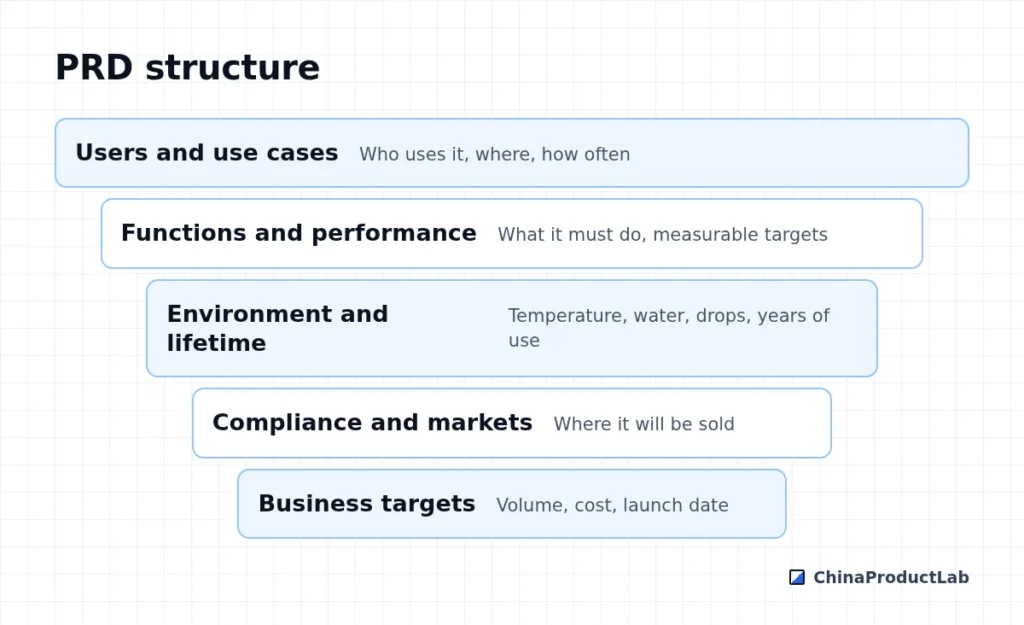
What to include
| Requirement | Weak | Useful |
|---|---|---|
| Battery life | “Long battery life” | “At least 7 days with 20 readings per hour” |
| Durability | “Rugged” | “Survives 1.2 m drops onto concrete, 6 faces” |
| Environment | “Outdoor use” | “Operates −20 to +50 °C, rain exposure” |
| Cost | “Affordable” | “Landed cost target at 5,000 units/year” |
Writing good requirements
- Measurable — a test can confirm it
- One requirement per line, with an ID for traceability
- Priority: must, should, nice to have
- Source: customer, regulation, business
- Free of solutions where possible (“must be waterproof”, not “must use an O-ring”)
- Owner who can approve changes
Using the PRD with suppliers
Manufacturing partners quote more accurately and propose better options when they understand the requirements behind a design. Share the relevant parts of the PRD — environment, lifetime, volumes and cost targets — together with drawings. A supplier who knows the product must survive outdoor UV can recommend a stabilised resin; one who only sees a drawing will quote the material named on it.
Keep the PRD alive: review it at each build stage, record changes and their reasons, and link each requirement to a test. When the product goes to production, the PRD becomes the basis for validation reports and the next product generation.
A one-page starting point
A PRD does not need to be long to be useful. Many teams start with a single page and expand only where decisions require more detail. A practical first version answers:
- Who buys and who uses the product, and in which situations?
- What are the three to five functions that must work perfectly?
- Where is it used: indoor, outdoor, vehicle, water, temperature range?
- How long must it last, and how is it powered?
- In which countries will it be sold, and through which channels?
- What volume is expected in the first two years, and what landed cost is needed?
- What is explicitly out of scope for this version?
Answering “out of scope” is surprisingly powerful: it stops features from creeping in during development and keeps the first product realistic. Revisit the list at every design review and record which answers changed.
Common gaps
- Packaging, accessories and manuals not considered
- Service and repair requirements missing
- Markets and certifications decided too late
- No volume assumption, so process choices cannot be made
- Cost target given as a retail price instead of a landed cost
Related: EVT, DVT and PVT, RFQ checklist and product development. Share your requirements to start a project.