
Two housing halves must be held together — permanently or for service, sealed or not, fast enough for production. The joining method affects part design, tooling, cycle time, sealing and whether the product can ever be repaired. It should be chosen while the parts are designed, because each method needs specific features molded into the parts.
Methods compared
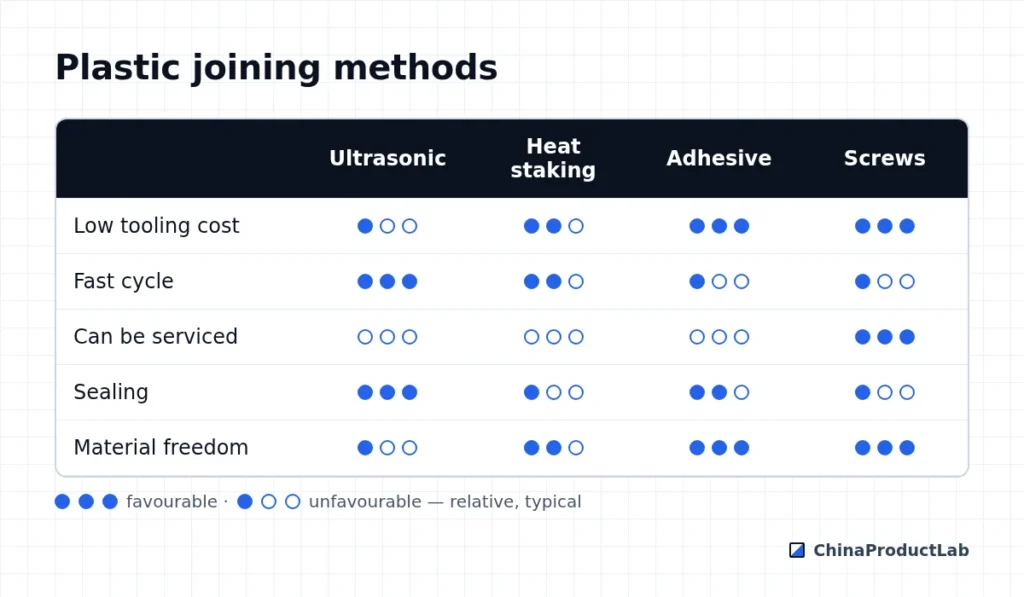
| Method | Strengths | Limits |
|---|---|---|
| Ultrasonic welding | Fast, strong, can seal; no consumables | Needs compatible materials, horn and fixture; permanent; can damage nearby electronics if not designed for |
| Heat staking | Simple, holds PCBs and parts with molded posts | Low strength; not a seal |
| Adhesives | Joins different materials, can seal | Cure time, surface preparation, process control |
| Snap fits | No consumables, fast assembly | Limited sealing; design and material dependent |
| Screws | Strong, serviceable | Assembly time, visible fasteners, bosses needed |
Designing for ultrasonic welding
- Joint design with an energy director or shear joint suited to the material
- Compatible materials — similar melt temperatures and chemistry
- Part geometry that transmits vibration to the joint (near-field welding is easier)
- Flash traps where weld flash would be visible
- Avoid fragile features and sensitive components near the weld
- Fixture that supports the part under the joint
Amorphous plastics such as ABS and PC usually weld more easily than semi-crystalline ones like PP and PA, which need different joint designs and more energy. Glass fillers and some additives also change weldability — involve the welding equipment supplier or molder early.
Heat staking and adhesives
Heat staking melts molded posts to form a head that captures a PCB, a window or a metal part. It is cheap and quick, but each stake holds only modest loads. Adhesives open up material combinations (plastic to metal, glass to plastic) and can seal, but require clean surfaces, controlled dispensing and curing time. Consider the production line: a 24-hour cure needs space and work-in-progress.
Validating a joint
Whatever the method, define how the joint will be validated and controlled in production:
- Destructive tests on samples: pull, peel or burst strength with a minimum value
- Leak or pressure-decay test when the joint must seal
- Visual criteria for flash, marks and gaps on cosmetic surfaces
- Process monitoring: weld energy, time and collapse distance for ultrasonic welding; dispense weight for adhesives
- Periodic re-testing during production, for example at shift start
Ultrasonic welding machines can record energy and collapse for every weld and reject parts outside the window, which provides strong process control at volume. For adhesives, control surface cleanliness and mixing ratios, and keep retained samples from each batch. These controls belong in the control plan from the first production run.
Choosing
- Must the product be opened for repair or battery replacement?
- Does the joint need to seal against water or dust?
- What volume justifies welding horns and fixtures?
- Are there sensitive electronics near the joint?
Related: box build assembly, molding design rules and injection molding. Ask for a joining recommendation.