Payment terms decide who carries the risk when something goes wrong. Pay everything upfront and you have little leverage if quality is poor; ask for long credit as a new customer and good suppliers may decline. Understanding the common structures — and linking payments to milestones you can verify — protects both sides.
This is general information, not legal or financial advice. Check contracts and payment instruments with your advisors and bank.
Common structures
| Term | How it works | Risk balance |
|---|---|---|
| Deposit + balance (T/T) | Part paid at order, the rest before shipment | Common for new relationships; balance gives leverage until shipment |
| Tooling: split payments | Part at kickoff, rest at sample approval | Links payment to progress |
| Letter of credit (L/C) | Bank pays against agreed documents | Secure for both, but costly and document-heavy |
| Open account (net 30/60) | Pay after delivery | Buyer favoured; usually after an established relationship |
Linking payments to milestones
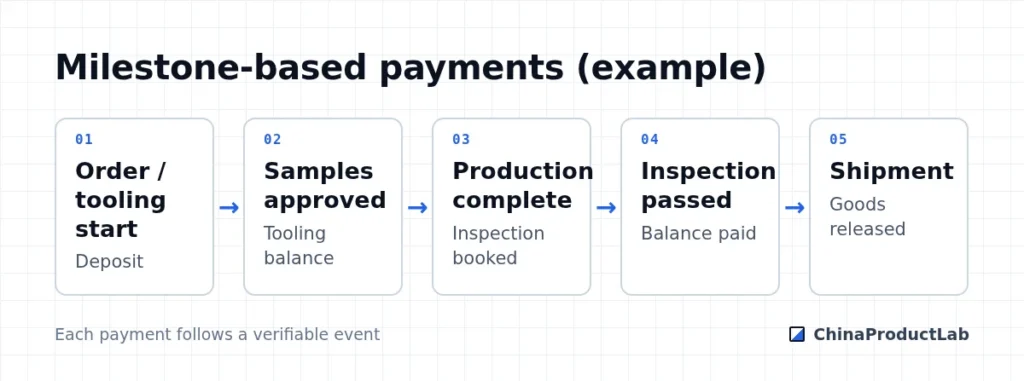
The most important control is simple: book a pre-shipment inspection before paying the balance, and make the inspection criteria part of the order. Once the balance is paid and goods are shipped, remedies become slow and expensive.
Protecting payments
- Verify the supplier’s company name and bank account match the contract
- Confirm any change of bank details by phone with a known contact — invoice fraud through fake emails is common
- Pay company accounts, not personal accounts
- Keep payment records linked to purchase orders
- Agree in writing what happens with defects found after payment
Tooling and sample payments
Tooling is often paid separately from production. A common structure is part of the tooling cost at the start and the balance after samples are approved. Make “approved” specific: samples meet the drawing and golden sample requirements, confirmed in writing. Clarify who pays for mold modifications caused by supplier errors versus design changes requested by you.
Also agree what you receive for the tooling payment: ownership of the mold, the right to transfer it, and documentation. Payments for samples and prototypes are usually made in full upfront because the amounts are small. Keep these small transactions efficient so that the relationship starts smoothly, and save detailed negotiation for production terms.
Currency and price changes
Agree the currency of the quotation and how long prices are valid. For long projects, discuss how changes in material prices or exchange rates will be handled — fixed prices for a period, or adjustments linked to a published index.
Building better terms over time
Terms usually improve with history: on-time payments, repeat orders and clear communication build trust. After several successful orders, propose lower deposits or partial credit. Suppliers also value predictability — a forecast and planned orders can be worth more to them than slightly faster payment.
Related: choosing a manufacturing partner, inspections in China and Incoterms.