The datasheet says IP67; the first rain test fills the housing with water. Ingress protection is achieved by the whole enclosure system — housing stiffness, gasket, fasteners, openings — not by adding a seal at the end. Design it in from the first CAD model.
IP ratings are defined in IEC 60529. Claims should be supported by tests on the final design — confirm test conditions with your lab.
What the digits mean
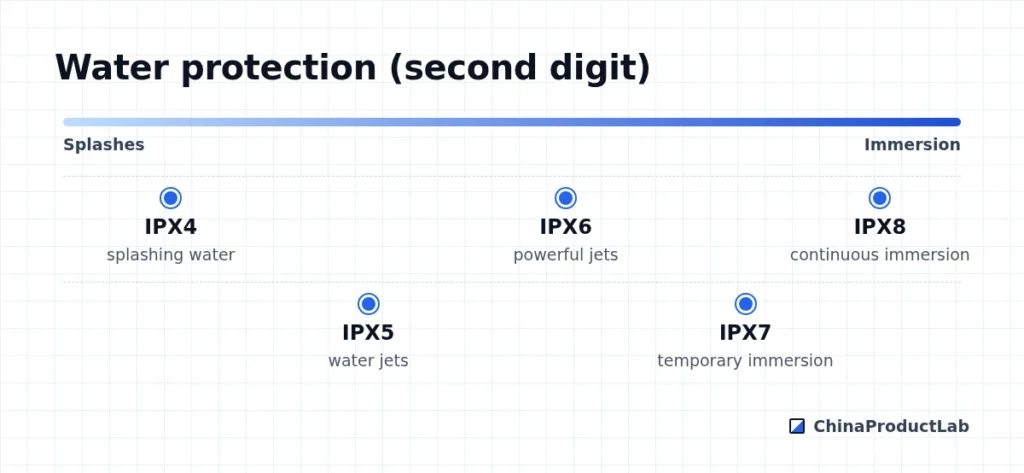
| Rating | Solids (1st digit) | Water (2nd digit) |
|---|---|---|
| IP54 | Dust-protected | Splashing water from any direction |
| IP65 | Dust-tight | Water jets |
| IP66 | Dust-tight | Powerful water jets |
| IP67 | Dust-tight | Temporary immersion (defined depth and time) |
| IP68 | Dust-tight | Continuous immersion under conditions agreed with the manufacturer |
Note: passing immersion (IPX7) does not automatically mean passing water jets (IPX5/6) — they are different tests.
Design checklist
- Gasket type chosen early: molded O-ring in a groove, die-cut gasket, or formed-in-place
- Groove dimensions and compression from the gasket supplier’s guidelines
- Stiff flanges and close screw spacing so compression is even
- Cable glands or sealed connectors rated for the target IP level
- Sealed buttons (membranes, overmolded keys) and sealed displays/windows
- Pressure-equalizing membrane vents to avoid seals being pushed by temperature changes
- Tolerance stack-up checked so the gasket is compressed at both extremes
Why enclosures fail IP tests
- Housing flexes between screws, so the gasket loses compression in the middle of long edges
- Gasket compression set after aging — the seal worked when new but not after heat cycles
- Leaks through screw holes, light pipes, labels or speaker openings that were not part of the seal design
- Cable entry sealed for the cable diameter of the prototype, not the production cable
- Ultrasonic welds or glued joints with gaps or voids
- Pressure difference after cooling pulls water through small paths
Ask suppliers which gasket material and hardness they propose, how gasket compression is controlled in production, and how sealing will be verified per batch — for example, by a leak or pressure-decay test on a sample of assembled units. A production test catches assembly mistakes that a one-time type test cannot.
Choosing the right rating
Higher is not always better. Each step up in IP rating adds cost to sealing, testing and assembly, and may make service and heat dissipation harder. Choose the rating from the real use environment: indoor equipment exposed to occasional splashes may need IP54, outdoor devices exposed to rain often target IP65 or IP66, and products that can be dropped in water may need IP67.
Ask also whether the product must be sealed during charging, with cables connected, or with covers open. Those states are often where water enters in real use.
Test early
Run informal water and dust checks on prototypes, then formal tests on production-intent parts. Repeat after changes to the gasket, the housing material or the supplier.
Related: enclosure materials, thermal design and IoT hardware. Send your enclosure design.