
Edge AI products — smart cameras, robots, inspection systems — run neural networks locally instead of in the cloud. The prototype often runs on a popular development board; the production product needs a platform that can be bought for years, fits the thermal and power budget, and has software support for the models you run. Choosing well early saves a painful port later.
Module or chip-down?
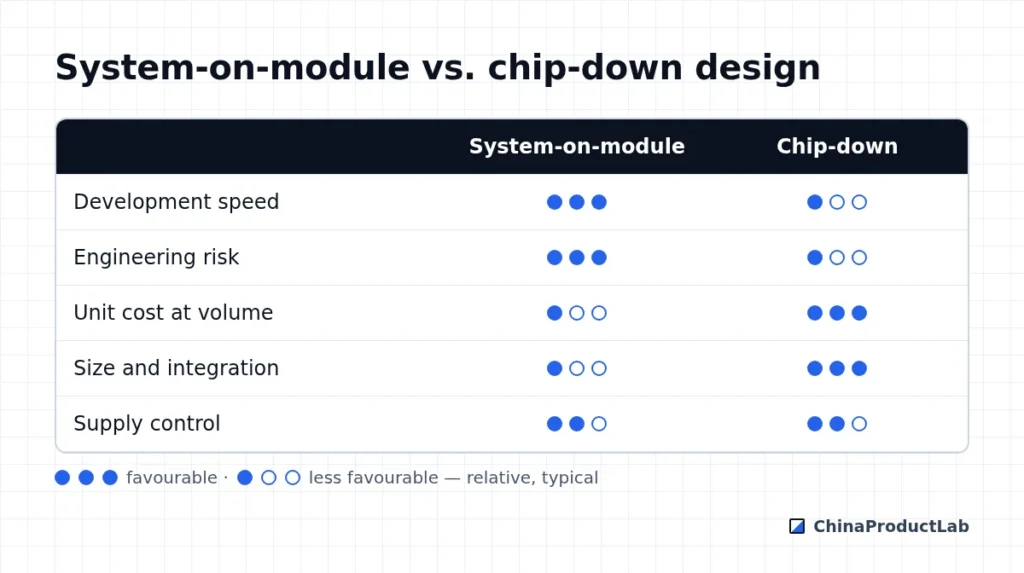
A system-on-module (SoM) packages processor, memory and power management on a small board that plugs into your carrier board. It removes the hardest layout work and shortens development. Chip-down designs reduce unit cost and size at volume but require experienced high-speed design and more validation.
Selection criteria
- AI performance for your actual model, measured — not only peak TOPS
- Supported frameworks, model conversion tools and quantisation
- Memory size and bandwidth for the model and video pipeline
- Camera and display interfaces (MIPI CSI, USB, Ethernet)
- Power consumption and heat at sustained load
- Operating temperature range
- OS and long-term software support (security updates)
- Production lifetime and availability commitments
Thermal and power
AI accelerators throttle when hot. Benchmarks on an open bench with a fan do not reflect a sealed enclosure in summer. Measure sustained performance in the real enclosure, and design heat paths — heat spreaders, thermal pads, metal housing sections — early.
| Check | Why |
|---|---|
| Sustained inference rate in enclosure | Throttling reduces performance |
| Peak current on startup and inference bursts | Power supply sizing |
| Surface temperature | User safety and comfort |
Software as part of the hardware choice
For edge AI, the software ecosystem often matters more than raw performance. Check the vendor’s model conversion tools, supported operators, documentation and community, and test your own model end to end before committing. Some accelerators run common networks well but struggle with custom layers, forcing fallbacks to the CPU that destroy performance.
- Board support package quality and update frequency
- Long-term kernel and security update support
- Licensing terms for SDKs and runtime libraries
- Tools for deploying and updating models in the field
- Availability of engineers familiar with the platform
Prototype on the production platform
Development boards are convenient, but if the production platform differs, performance and behavior can change. Move to the intended module or a development kit for it as soon as possible, and benchmark the real application — camera pipeline, model and application logic together. Measure latency, accuracy after quantisation, power and temperature. These numbers form the baseline for production testing and future software updates.
Supply and lifecycle
Ask module vendors about production life, change notifications and pricing at your volumes. Keep the carrier board design compatible with pin-compatible module families where possible, so you can move to a newer module without redesigning the whole product.
Related: thermal design for edge AI, BOM shortage risk and AI hardware.